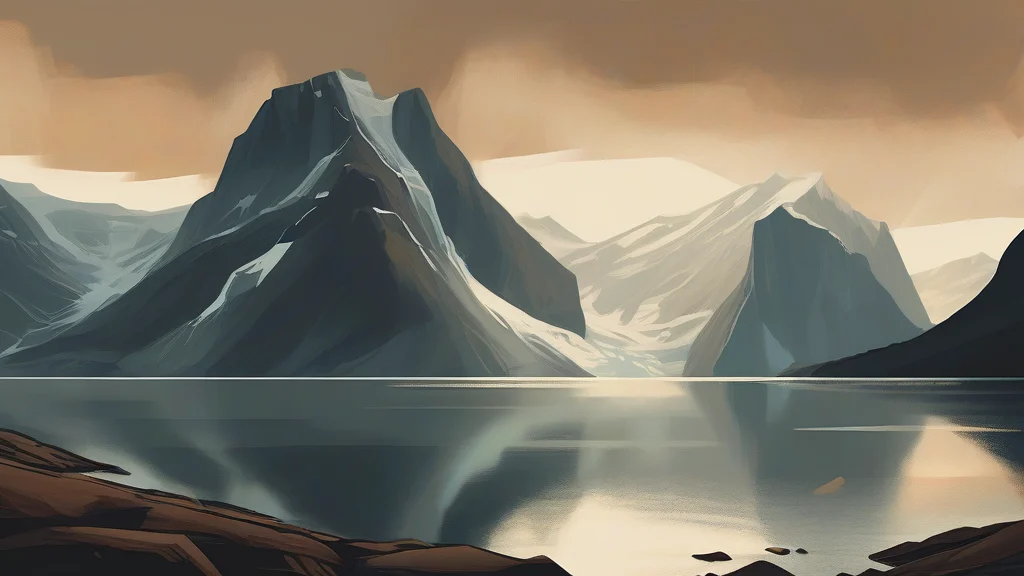
What does fjord mean?
A fjord is a long, narrow inlet of the sea bounded by steep cliffs or slopes, created when a glacier excavates a valley far below sea level and the resulting trough is flooded by the ocean, typically as ice sheets melt. Fjords are among the most dramatic coastal features on Earth: they can run hundreds of kilometres inland and plunge to depths exceeding a thousand metres, while their entrances are often shallower sills left by terminal moraines. The word is closely associated with Norway, whose western coastline is famously serrated by fjords such as the Sognefjord and Geirangerfjord, but comparable landscapes occur in Iceland, Greenland, Alaska, British Columbia, Chile, and New Zealand. Beyond geography, 'fjord' evokes stark, majestic scenery — sheer rock walls, cascading waterfalls, and mirror-still water — making it a favourite term in travel writing and tourism. It is a concrete, descriptive noun with little figurative use.
nounA long, narrow, deep inlet of the sea bordered by steep cliffs, formed when a glacier carves a valley that is later flooded by rising seawater.
- A long, narrow sea inlet with steep sides or cliffs, created by glacial erosion and subsequently flooded by seawater.
"The cruise ship glided slowly through the narrow fjord, its passengers dwarfed by the sheer cliffs rising on either side."
"Geirangerfjord, with its waterfalls tumbling down near-vertical rock walls, draws visitors from around the world."
"As the ice retreated at the end of the last glacial period, seawater flooded the deepened valleys, forming the fjords that define Norway's western coast."
Standard regular plural; used freely when referring to multiple inlets, e.g. the fjords of western Norway.
"The fjords of Milford Sound country in New Zealand rival those of Norway in grandeur."
Norway's Sognefjord plunges more than 1,300 metres deep — over three times the height of the Eiffel Tower, inverted.
Reviewed by Deb Chak, Editor. AI-assisted content curated by RJS Tech Solutions LLP.
Etymology of fjord
The word 'fjord' comes from Norwegian 'fjord', borrowed into English in the mid-19th century as travellers and geologists described Scandinavian scenery, though an earlier anglicised form, 'fiord', appeared in the late 18th century via Danish. The Norwegian term derives from Old Norse 'fjǫrðr', which traces back to Proto-Germanic *'ferþuz', meaning a crossing point or stretch of water one can traverse. This root also yields related Germanic water-feature words such as the Scottish 'firth' (as in the Firth of Forth) and German 'Förde', showing how widely the concept spread across northern Europe.
Related word forms
How fjord is actually used
The spelling 'fjord' reflects Norwegian orthography; the older anglicised form 'fiord' also appears in older British sources. In Scotland and northern England the same geological feature appears in place-names as 'firth' or 'voe'. The word carries connotations of dramatic Nordic scenery and is strongly associated with Norway, though fjords also occur in Iceland, Greenland, Chile, New Zealand, and Canada.
Easily confused with fjord
A sound is a broad marine channel or inlet, often formed by drowning of a river valley or between land masses, whereas a fjord is specifically a glacier-carved valley flooded by the sea, typically deeper and steeper-walled.