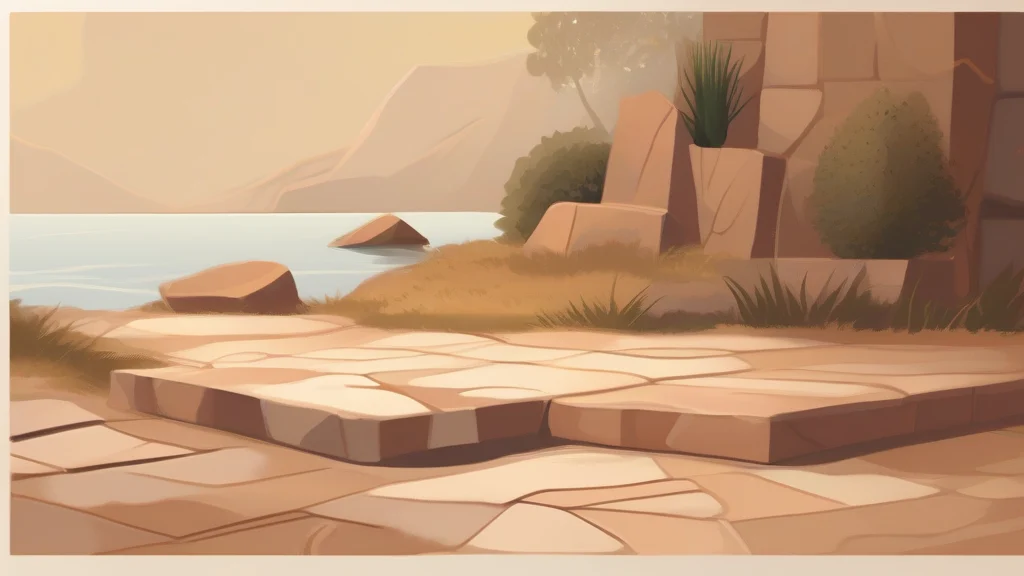
What does flagstone mean?
A flagstone is a flat slab of stone, usually split from layered rock such as sandstone, limestone, or shale, used to pave paths, patios, courtyards, and interior floors. The term refers both to the individual slabs and, more broadly, to the durable paving material they form. Because the stone splits naturally along its sedimentary layers, flagstones have slightly irregular, characterful surfaces rather than machine-perfect faces, giving paved areas a rustic, timeless quality prized in garden design and traditional architecture. The word entered English in the seventeenth century, its 'flag' element deriving not from a banner but from an Old Norse root meaning a flat stone slab. Commonly found in phrases like 'flagstone path' and 'flagstone patio,' the word appears frequently in real estate listings, gardening guides, and historical writing. It evokes sturdy craftsmanship and old-world charm, making it useful vocabulary for anyone interested in landscaping, architecture, or heritage properties.
nounA flat, rectangular slab of stone, typically split from stratified rock such as sandstone or limestone, used for paving walks, patios, and floors.
- A flat slab of stone used for paving paths, patios, and floors.
- The material itself — split stone used as a paving surface (e.g. a flagstone floor).
"The garden path was paved with weathered flagstones that glowed warm gold in the evening light."
"She crossed the courtyard, her heels clicking on the uneven flagstones."
"They chose local flagstone for the new patio because it blends so naturally with the garden."
The regular plural applies when referring to individual slabs. As a mass noun describing the paving material, the singular form is used without inflection.
"The workers laid the flagstones in a herringbone pattern across the terrace."
That 'flag' in flagstone has nothing to do with banners — it comes from an old Norse word meaning a slab of stone you could split flat like a sheet.
Reviewed by Deb Chak, Editor. AI-assisted content curated by RJS Tech Solutions LLP.
Etymology of flagstone
Flagstone entered English in the early seventeenth century, combining 'flag' with 'stone.' Here 'flag' does not refer to a banner but derives from Old Norse 'flaga,' meaning a flat stone slab or layer — the same root behind the verb 'flake' (as in flaking layers off). Scandinavian influence on northern English place names and terminology supports this Norse origin. Cognates appear in other Germanic languages, reflecting a shared Germanic word for naturally splitting stone.
Related word forms
How flagstone is actually used
In building and landscaping contexts, 'flagstone' often refers both to the individual slabs and to the paving material collectively; context makes clear which is meant. The singular form can act as a mass noun ('a floor of flagstone'). The word carries rustic, traditional connotations, evoking cottage gardens and old European streetscapes.
Easily confused with flagstone
Cobblestones are small, rounded river stones set in sand or mortar, whereas flagstones are large, flat slabs of quarried rock.