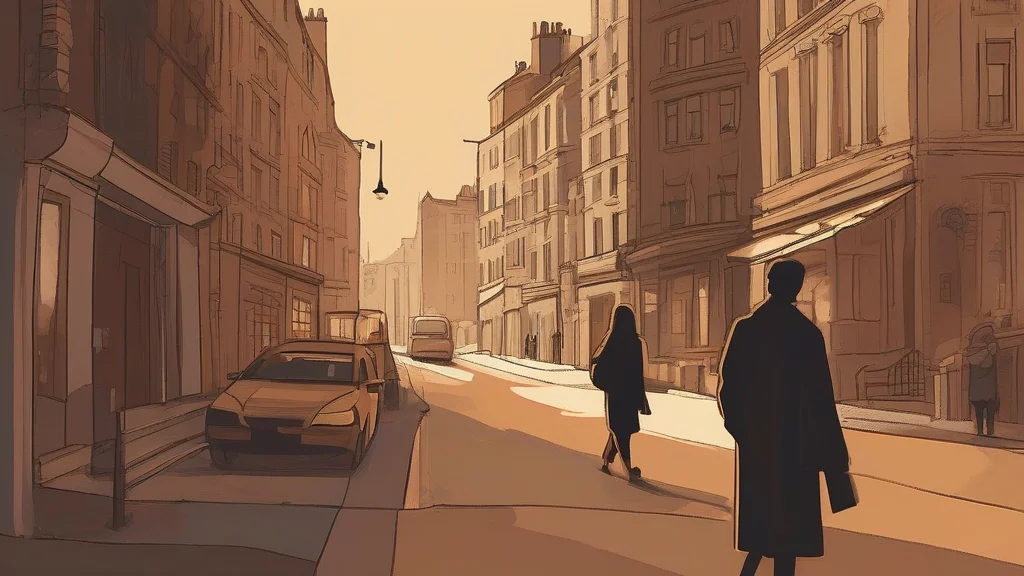
What does flaneur mean?
A flaneur is a person who wanders through city streets slowly and deliberately, observing the life around them with keen, detached curiosity. Borrowed directly from French in the nineteenth century, the word became central to writing about modern urban experience, most famously through Charles Baudelaire's portrait of the artist-flaneur and Walter Benjamin's studies of Paris. The term carries distinctly positive, even romantic connotations: it suggests not idle loafing but a kind of connoisseurship of the street, in which watching crowds, window displays, and passing scenes becomes an art. Today, flaneur appears mostly in literary criticism, sociology, and travel writing, often used to describe anyone who savors a city on foot rather than rushing through it. Its endurance reflects a lasting ideal: that attention itself can be a pleasure.
nounAn idler who strolls through city streets observing urban life with detached, cultivated curiosity; a connoisseur of the street. The term carries connotations of leisurely, contemplative wandering rather than aimless loitering.
- A person who wanders city streets leisurely and observantly, especially as a detached student of urban life.
- (Extended/literary use) Anyone who strolls or observes in an unhurried, appreciative way.
"He fancied himself a flaneur, drifting through the boulevards of Paris with no destination in mind."
"Walter Benjamin described the flaneur as the essential figure of the modern city, at home amid the crowd yet always apart from it."
"With her camera slung around her neck, she spent the afternoon as a flaneur among the market stalls."
The anglicized plural flaneurs is standard in English; writers preserving French diacritics use flâneurs. Both are acceptable if used consistently.
"The café terraces were crowded with flaneurs taking in the evening spectacle."
The flaneur was invented by the French as an art form: doing absolutely nothing, but doing it beautifully and with great intellectual purpose.
Reviewed by Deb Chak, Editor. AI-assisted content curated by RJS Tech Solutions LLP.
Etymology of flaneur
Flaneur comes from the French verb flâner, meaning to stroll or saunter idly, which emerged in French in the early nineteenth century alongside the noun flâneur. The exact deeper origins of flâner are uncertain, though it has been linked to Old Norse flana, 'to rush about.' The noun became famous through Charles Baudelaire's writings on the modern artist-observer in the mid-nineteenth century and was later developed by Walter Benjamin. Its French derivative flânerie denotes the activity of strolling observantly.
Related word forms
How flaneur is actually used
Flaneur is a loanword from French, usually italicized in print, and belongs to a literary, somewhat highbrow register. It is common in cultural criticism, urban studies, and discussions of Baudelaire and Walter Benjamin. It typically implies leisure, education, and aesthetic sensitivity; applying it to mere laziness misses the point. The plural may be written flaneurs or, following French, flâneurs.