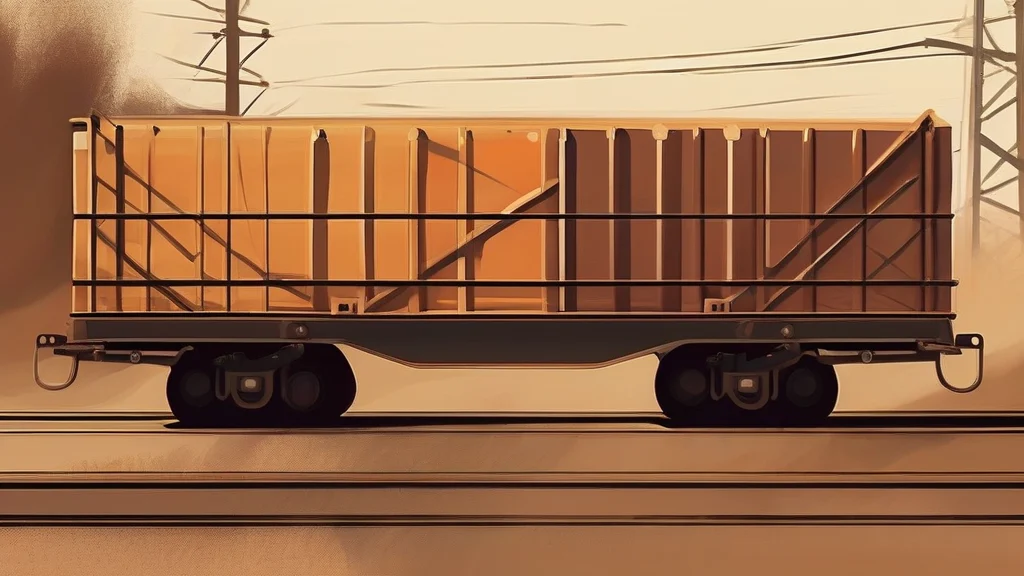
What does flatcar mean?
A flatcar is a type of railroad rolling stock consisting of little more than a sturdy, level platform mounted on wheels, with no walls, roof, or sides of its own. This deliberately bare design is precisely its strength: it allows cranes to load items from above and permits freight of almost any shape — tractors, steel beams, military vehicles, wind-turbine blades, or standardized shipping containers — to be strapped directly to the deck. Flatcars made modern intermodal transportation possible, since containers can be lifted off trucks and onto trains seamlessly. The term is standard in American usage, while British railways use the closely related 'flat wagon'. Though primarily a freight-industry word, flatcar appears regularly in news coverage of rail transport and logistics, making it useful vocabulary for anyone following commerce, infrastructure, or industrial history.
nounA railroad freight car with a flat, open deck and no sides or roof, used to carry heavy or oversized loads such as machinery, vehicles, containers, or construction equipment.
- A railroad car consisting of an unenclosed horizontal platform on which freight is loaded directly.
- (By extension) a similar flat platform vehicle used for transporting heavy goods in other contexts.
"The wind turbines were shipped across the country on a line of flatcars."
"A flatcar carrying a massive transformer rolled slowly through the rail yard."
"The circus traveled by train, its elephants riding aboard specially strengthened flatcars."
Standard countable noun plural; flatcars are typically discussed in groups when referring to a train consist.
"Two dozen flatcars sat idle in the siding."
Without flatcars, there would be no intermodal shipping — every shipping container that rides a train does so on a flatcar's bare deck.
Reviewed by Deb Chak, Editor. AI-assisted content curated by RJS Tech Solutions LLP.
Etymology of flatcar
The word flatcar is a transparent compound of 'flat' and 'car', both long-established in English. 'Flat' traces back through Middle English to Old Norse 'flatr', meaning level or even, while 'car' derives ultimately from Latin 'carrus', a wheeled vehicle borrowed into Gaulish Vulgar Latin and passed into English via Norman French. The compound arose in nineteenth-century America alongside the growth of the railroads, when such open-platform cars became a standard category of freight rolling stock.
How flatcar is actually used
Flatcar is primarily an American English term; British English uses 'flat wagon' or simply 'flat' for the equivalent railway vehicle. The word is technical but not obscure, appearing in freight-industry language and general journalism about rail transport.
Easily confused with flatcar
A flatbed is the equivalent open-deck vehicle for trucks on roads, whereas a flatcar is specifically a railroad car.