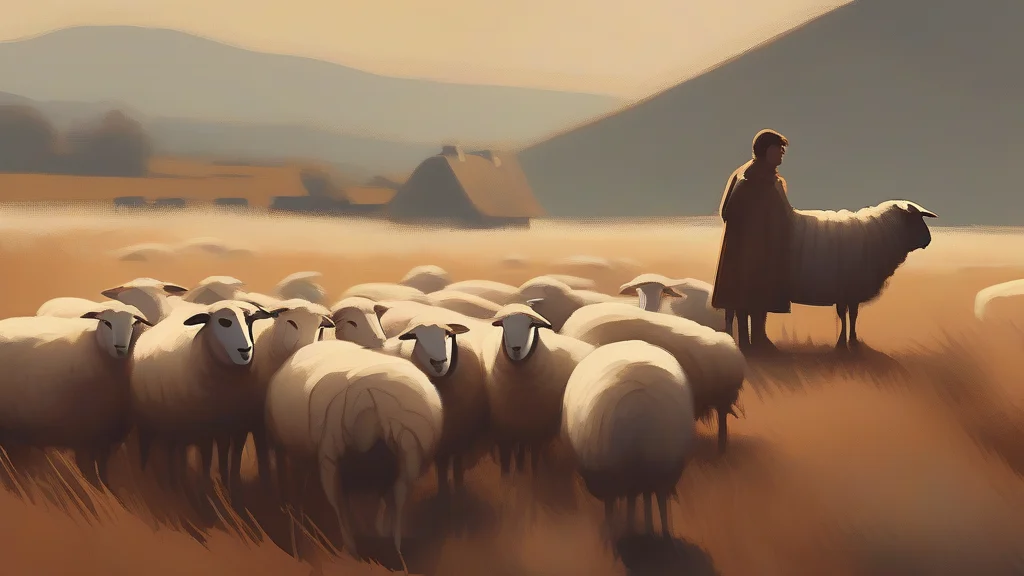
What does flockless mean?
Flockless is an uncommon English adjective meaning 'having no flock.' Its natural home is pastoral language: a flockless shepherd is one who keeps no sheep, whether through loss, poverty, or the ending of a way of life. Because the word so often appears alongside shepherding imagery, it has taken on an emotional charge beyond its plain definition — to be flockless suggests being stripped of one's purpose, charges, or companions, and writers have used it to evoke solitude and desolation. The word is formed by adding the suffix '-less' (meaning 'without') to the noun 'flock', the long-established term for a group of sheep, goats, or birds. Flockless is rare enough that it surprises most readers on first encounter, which is precisely its value: in the right literary context it delivers a vivid image of emptiness and loss that more ordinary adjectives cannot match. It belongs to formal and poetic registers rather than everyday conversation.
adjectiveHaving no flock; used chiefly of a shepherd or herdsman who keeps no sheep or other herd animals, or of imagery evoking such a figure.
- Lacking a flock — said especially of a shepherd or keeper who has no sheep or herd under his care.
"The flockless shepherd wandered the hills, his crook long since hung on the wall."
"Left flockless after the wolves came, the old shepherd sold his crook and left the valley for good."
"The poem paints a flockless figure standing alone on an empty hillside."
Reviewed by Deb Chak, Editor. AI-assisted content curated by RJS Tech Solutions LLP.
Etymology of flockless
Flockless derives from the noun 'flock', a word of Old English origin (recorded as 'flocc'), meaning a company of animals — especially sheep, goats, or birds — kept together. The adjective is formed with the suffix '-less', from Old English 'lēas' ('free from, without'), the same suffix that builds words like 'sleepless' and 'hopeless'. It therefore shares its root with other flock-related terms such as 'flockmaster'. The word has always been marginal in usage, appearing mainly in literary contexts where the absence of a flock carries symbolic weight.
How flockless is actually used
Flockless is a rare, largely literary word. It appears almost exclusively in poetry, pastoral writing, and metaphorical prose rather than in everyday speech, and it carries a strongly melancholic or desolate connotation when used figuratively.
Easily confused with flockless
A flock is a group of birds or sheep, while flockless describes the absence of such a group.