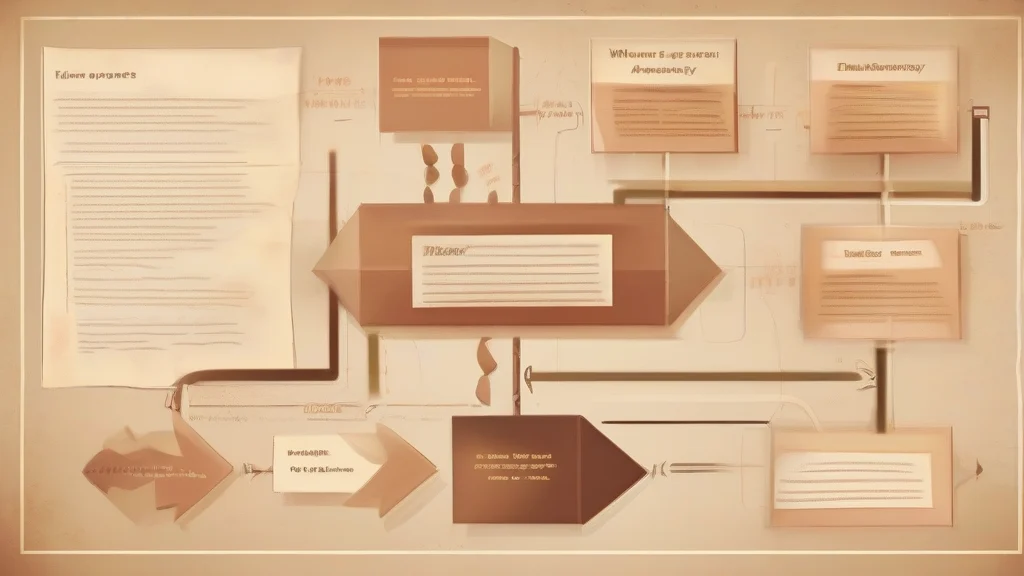
What does flowchart mean?
A flowchart is a diagram that maps out a process from start to finish, using standardised symbols connected by arrows to show each step, the order in which steps occur, and the points where decisions must be made. Rectangles typically denote actions, diamonds mark decision points where a question branches into different paths, and arrows indicate the direction of progress. Flowcharts are widely used in engineering, software development, business administration, education, and manufacturing to document procedures, analyse workflows, plan projects, and communicate complex processes clearly. They are valued because they make logic visible: inefficiencies, redundancies, and ambiguities that are hard to spot in written instructions often become obvious when drawn as a chart. The word is neutral and practical in tone, appearing equally in formal documentation and everyday workplace discussion. Simple enough to sketch on a whiteboard yet rigorous enough to specify computer algorithms, the flowchart remains one of the most enduring tools for organising thought and explaining how things work.
nounA diagram that represents a process, workflow, or system, using symbols such as boxes, diamonds, and arrows to show steps and the sequence or decision points connecting them.
- A diagram using standardized symbols (rectangles for steps, diamonds for decisions, arrows for direction) to depict the sequence of stages in a process or workflow.
- An extended use: a step-by-step plan or procedure presented as if laid out in such a diagram, as in 'a flowchart of events' describing a sequence narratively.
"Before writing any code, the team sketched a flowchart to map out how user requests would move through the system."
"The onboarding flowchart made it clear exactly which approvals were needed at each stage."
"In the report, she traced a flowchart of decisions that had led to the delay."
Regular plural; used freely whenever referring to multiple diagrams.
"The appendix contained flowcharts for all twelve approval procedures."
The diamond in every flowchart — the decision box — was part of the original design from the 1920s, making it one of the few office tools older than the computer it now helps program.
Reviewed by Deb Chak, Editor. AI-assisted content curated by RJS Tech Solutions LLP.
Etymology of flowchart
The word flowchart combines two English words: 'flow', from Old English 'flōwan' meaning to stream or run like water, and 'chart', borrowed via French 'charte' from Latin 'charta', meaning a sheet of papyrus or paper. Both elements are transparent English roots rather than classical ones, so its closest relatives are simply other compounds and derivatives of these same native words. The compound arose in early twentieth-century industrial engineering, when process engineers began documenting workflows graphically, and it spread through computing after the Second World War as programmers adopted charts to plan algorithms.
How flowchart is actually used
Flowchart is used in technical and business contexts alike; it is a neutral, practical term with no strong connotation. It is occasionally also spelled 'flow chart' as two words, especially in older British usage, though 'flowchart' is now the standard form.
Easily confused with flowchart
A diagram is any visual representation of information, while a flowchart is the specific type of diagram that shows sequential steps and decision points in a process using standardized symbols.