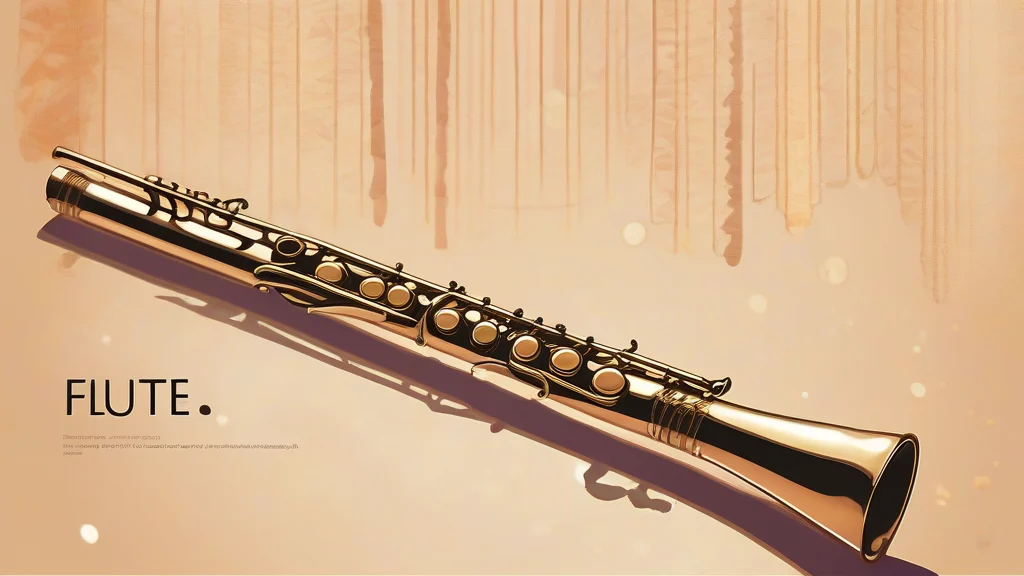
What does flute mean?
The flute is a wind instrument in which sound is produced by blowing air across an opening near one end of a tube, setting the air inside vibrating. Unlike reed instruments such as the clarinet or oboe, it relies purely on the player's breath directed across the embouchure hole. The modern orchestral flute is a silver or nickel tube held horizontally to the player's right, but the broader flute family spans countless cultures and forms, including vertical bamboo flutes in Asia, wooden fifes in military bands, and the high-pitched piccolo. The word also extends beyond music: champagne served in tall, tapering 'flutes', and the shallow grooves carved into classical columns are both called flutes. The instrument's lineage is extraordinarily ancient — bone flutes tens of thousands of years old rank among the earliest known musical instruments. People who play the flute are called flutists in American usage and flautists in British usage, and the instrument occupies a central place in orchestras, chamber music, folk traditions, and beginner instruction alike.
nounA musical wind instrument consisting of a long tube played by blowing air across a hole near one end, held horizontally in modern orchestral form; also, an architectural term for a groove or channel cut into a surface.
- A tubular wind instrument sounded by blowing across a hole near one end, typically held horizontally and made of metal or wood.
- A vertical end-blown pipe of any kind, such as a bamboo flute or recorder-type instrument.
- A groove or channel cut into a surface, as in the fluting of classical columns or on pastry and glassware.
- A tall, narrow glass shaped like a flute, used especially for champagne.
"She has played the flute in the school orchestra since she was ten."
"The flutist opened the concert with a delicate solo."
"Champagne was served in tall, slender flutes."
Regular plural; used for multiple instruments, glasses, or grooves.
"The orchestra seated its two flutes beside the oboes."
The flute is arguably humanity's oldest instrument — bone flutes over 40,000 years old have been unearthed in caves in Germany.
Reviewed by Deb Chak, Editor. AI-assisted content curated by RJS Tech Solutions LLP.
Etymology of flute
The word flute entered English in the early seventeenth century from Old French, where forms such as 'flaute' or 'flahute' denoted the instrument. Its ultimate origin is uncertain, though it is often traced toward Provençal or other Romance sources rather than a single well-documented ancestor. The word spread across European languages in closely parallel forms — Italian 'flauto', German 'Flöte', and French 'flûte' — reflecting the instrument's pan-European currency. Derivative terms such as 'flutist' and 'flautist' arose simply as names for the person who plays it.
Related word forms
How flute is actually used
As a musical term, flute is neutral in register and appears freely in both casual and formal contexts. The player's title varies regionally: 'flutist' is standard in American English, while 'flautist' is more common in British English; both refer to the same role. In non-musical uses (champagne glasses, architectural grooves), the meaning is always inferable from context and carries no special formality.
Easily confused with flute
The piccolo is a smaller, higher-pitched member of the flute family that sounds an octave above the standard flute.
A recorder is blown through a mouthpiece at the end of the tube and held vertically, whereas the modern flute is blown across a side hole and held sideways.