
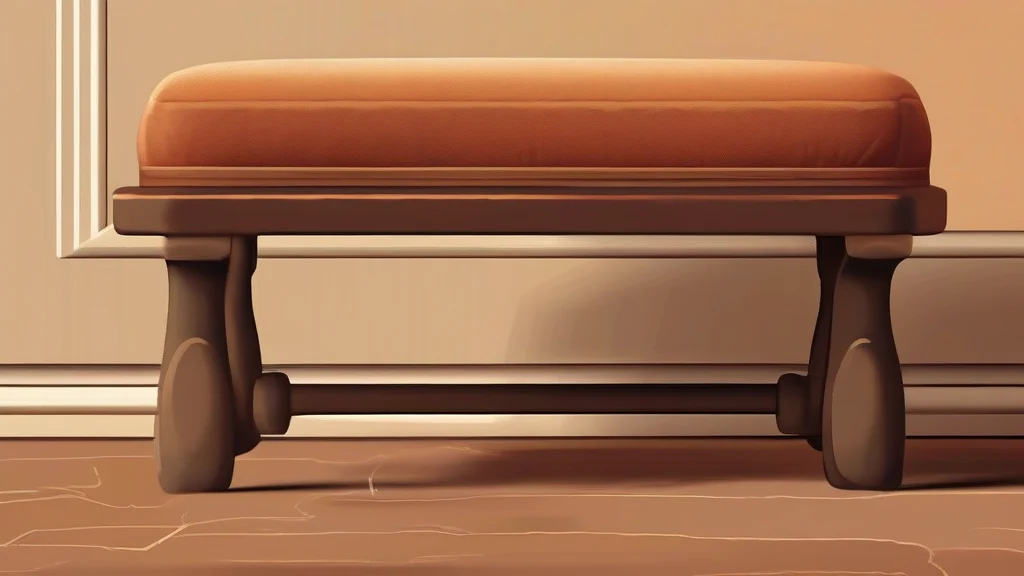
What does footstool mean?
A footstool is a low piece of furniture designed to support a seated person's feet. Typically small enough to sit close to a chair or sofa, footstools may be simple wooden stools or soft, upholstered cushions, and they are prized both for comfort — easing pressure on the legs and encouraging relaxation — and as decorative accents that tie a room together. The word also carries a figurative meaning rooted in scripture and classical literature: something 'beneath' a ruler's authority, as when the earth is called the footstool of God. This dual life makes 'footstool' a modest but evocative term, equally at home in interior-design writing and in devotional poetry. Its synonyms overlap with related furnishings like the ottoman and hassock, though each occupies its own niche in size and function. Practical, familiar, and quietly symbolic, the footstool remains one of the most enduringly useful objects in domestic life.
nounA low stool, often upholstered or with short legs, designed to rest or support a person's feet while seated; more broadly, anything treated as an object of support for another's elevation.
- A low support for the feet when seated, usually small and often upholstered.
- Figuratively (chiefly in religious or poetic language), a thing or place subordinated to someone's power or authority — e.g. 'the earth is his footstool'.
"She tucked the embroidered footstool beneath her feet as she settled into the armchair."
"He dragged the footstool closer to the hearth and propped his slippers on it."
"The old armchair came with its own matching footstool, worn smooth by decades of use."
Standard regular plural; no irregularities.
"The shop displayed a row of matching footstools along the wall."
In the Bible, the earth is described as God's footstool — turning a humble piece of furniture into a symbol of divine majesty.
Reviewed by Deb Chak, Editor. AI-assisted content curated by RJS Tech Solutions LLP.
Etymology of footstool
Footstool is a straightforward English compound formed from 'foot' + 'stool', with 'stool' deriving from Old French 'estout' / Germanic origins denoting a single-seat stand. The compound itself appears early in English vernacular writing, well before the modern era, reflecting the long history of the object in ordinary households. Its figurative biblical use — the earth as God's footstool — descends from Hebrew scripture via early English translations, giving the humble term an unexpectedly elevated literary pedigree.
How footstool is actually used
The word is neutral and everyday in register, common in both British and American household vocabulary. In religious and literary texts, 'footstool' carries a figurative sense of humility or subjugation, most famously in phrases such as 'the earth is thy footstool.'
Easily confused with footstool
An ottoman is a larger, often cushioned piece that may double as a coffee table, whereas a footstool is typically smaller and used solely to support the feet.
A hassock is a firm, low cushion for kneeling or resting the feet, while a footstool usually has legs and a rigid frame.