What does foresail mean?
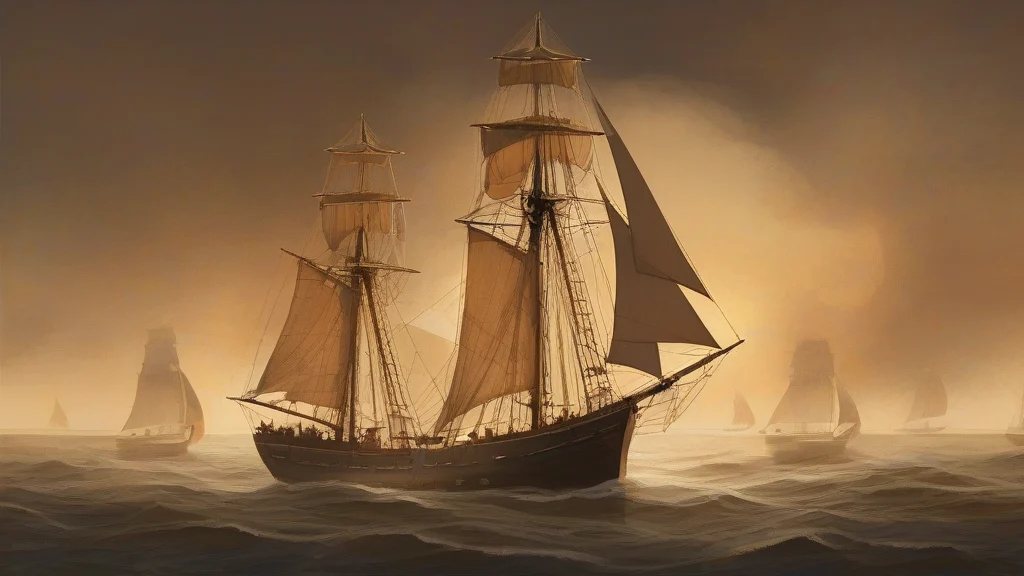
A foresail is one of the principal sails of a sailing vessel, though its exact position depends on the rig. On a traditional square-rigged ship, it is the lowest sail fastened to the yard of the foremast, the mast nearest the bow, forming part of the great wall of canvas that drove vessels like HMS Victory. On smaller fore-and-aft boats such as sloops and cutters, the foresail instead refers to the sail hoisted on the forestay at the front of the boat, ahead of the mainsail. In both senses it belongs to the specialized vocabulary of seafaring, appearing in sailing manuals, maritime history, and classic naval fiction. The word carries strong nautical connotations, evoking the age of sail and the teamwork required to hoist, reef, furl, and trim canvas. For anyone reading accounts of tall ships or learning to sail, the foresail is among the first terms encountered.
The lowest sail set on the foremast of a square-rigged vessel.
"Topmen scrambled aloft to loose the foresail as the ship cleared the harbour."
This is the standard sense in descriptions of full-rigged historical ships.
On a fore-and-aft rigged vessel, the sail set on the forestay ahead of the mast.
"She trimmed the foresail flat to beat upwind more efficiently."
In modern yachting this sail is often simply called a jib or genoa depending on its size.
The plural typically appears when referring to multiple vessels or to ships carrying more than one such sail.
"The fleet's foresails were set in unison as it put to sea."
Every great age-of-sail warship carried a whole ladder of sails above its foresail — topsails, topgallants, royals — all built on this one humble canvas foundation.
Reviewed by Deb Chak, Editor. AI-assisted content curated by RJS Tech Solutions LLP.
Etymology of foresail
Foresail combines the Old English prefix 'fore-', meaning 'before' or 'in front', with 'sail', from Old English 'segl'. As a compound, it arose in English during the medieval and early modern development of ocean-going rigs, when sailors distinguished the masts and sails toward the bow from those amidships and aft. It thus shares its two elements with a wide family of nautical and everyday terms formed with 'fore-', such as forecastle and foremost.
How foresail is actually used
A technical term of nautical usage, found mainly in maritime writing, sailing instruction, and historical accounts of tall ships. Its precise meaning depends on rig type: square-riggers carry it as the foremast's lower course, while fore-and-aft sailors use it for the headsail on the forestay.
Easily confused with foresail
The mainsail is the primary sail set on the mainmast, whereas the foresail is carried forward of it, either on the foremast or on the forestay.