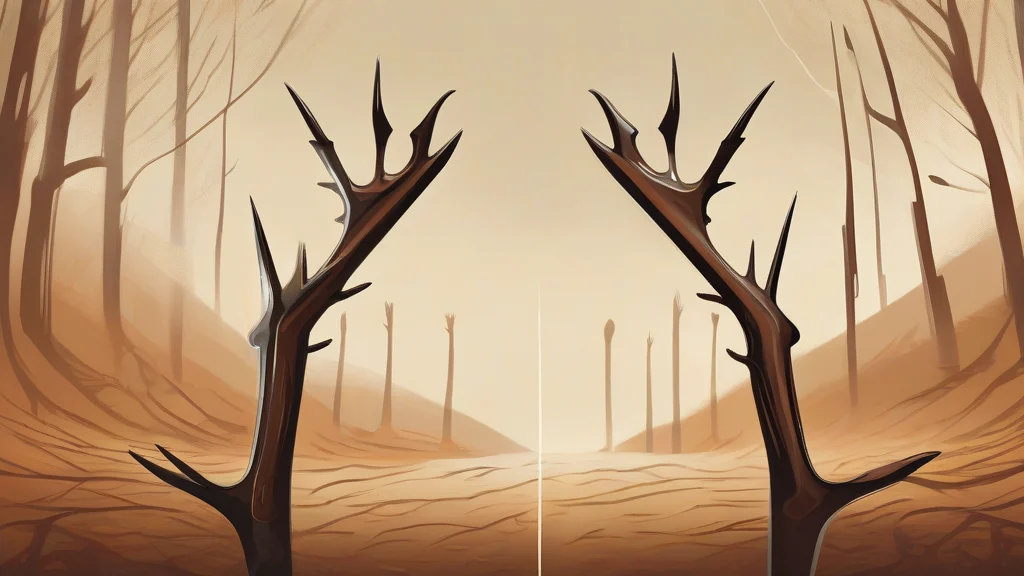
What does forked mean?
Forked describes anything that divides into two or more branches or prongs, taking its name from the familiar eating utensil whose split tines it resembles. The word appears most often before a noun: a forked road splits travellers in two directions, forked lightning tears across the sky in jagged forks, and a snake's forked tongue flickers into twin points. In literature and politics, the phrase 'forked tongue' has taken on a life of its own as a symbol of deceit — to speak with a forked tongue is to say one thing while meaning another. The adjective is neutral in register and common in both everyday and descriptive writing, from hiking directions to natural history. Its usefulness lies in its precision: rather than merely saying something is 'split', calling it forked immediately evokes a distinctive two-pronged shape, making it a compact and vivid descriptor.
adjectiveForked means divided into two or more branches or prongs, like the tines of a fork; it also describes something fork-shaped, such as a lightning bolt or a tongue.
- Divided into two or more branches or prongs (e.g. a forked road, forked lightning).
- Shaped like a fork; having prongs or points like those of a fork.
- (Of an animal's tongue or tail) split at the end into two parts.
"The hiker paused where the trail split into two forked paths."
"Lightning cracked across the sky in brilliant forked streaks."
"At the summit, we took the forked path that led toward the eastern ridge."
A snake's forked tongue isn't a weapon — it's a smell detector in stereo, letting the reptile taste the air in two directions at once.
Reviewed by Deb Chak, Editor. AI-assisted content curated by RJS Tech Solutions LLP.
Etymology of forked
Forked derives from the noun fork, which comes from the Old English 'forca' and related Germanic forms, ultimately traced to the Latin 'furca', meaning a pitchfork or two-pronged implement. The adjective arose simply by using the past participle of the verb 'to fork' descriptively. Latin 'furca' also gave Romance languages their words for fork, such as the Spanish 'horquilla' and Italian 'forchetta', making these distant cousins of the English term.
Related word forms
How forked is actually used
Forked functions almost exclusively as an attributive adjective — it usually appears directly before a noun (forked tongue, forked road) rather than as a predicate. It carries no strong connotation by itself, though 'forked tongue' has acquired a figurative association with deceit and double-dealing in political and literary language.
Easily confused with forked
"Fork" is the noun or verb referring to the utensil or the act of dividing or copying (as in software), while "forked" is typically an adjective describing something already divided into branches.