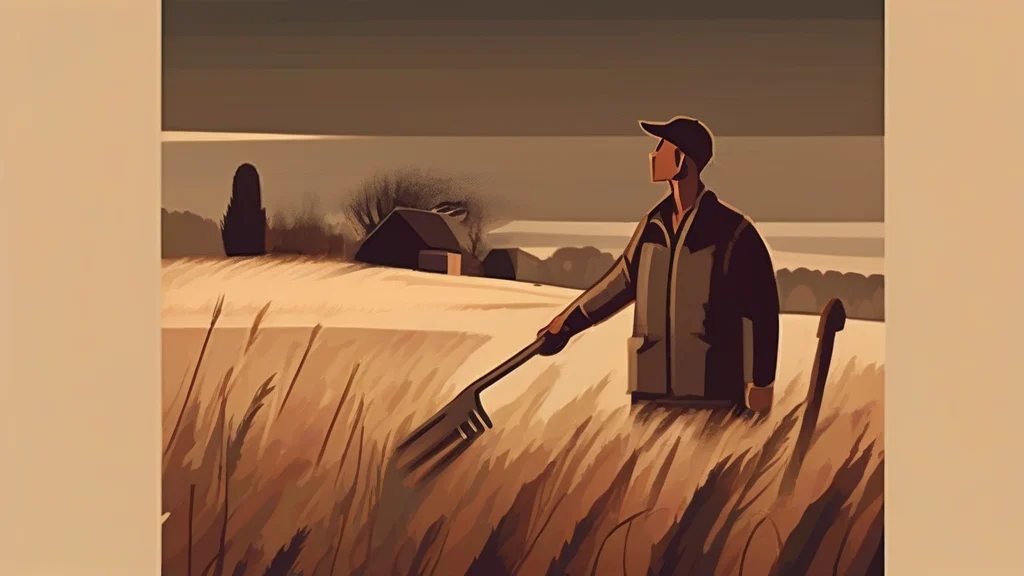
What does forker mean?
Forker is an uncommon English noun meaning a person who uses a fork — typically not the table utensil, but the long-handled farm or garden tool. In traditional agricultural settings, a forker was the hand tasked with jobs done by fork: pitching hay onto wagons, turning compost heaps, mucking out stables, or breaking clods of soil. The word follows a familiar pattern of English agent nouns, in which a tool's name gains an '-er' suffix to describe its user, much as 'ploughman' describes one who ploughs. Because it never entered widespread use, forker survives mainly in older rural vocabulary, dialect records, and occasional humorous or nostalgic reference rather than everyday speech. Readers encountering it today will usually find it attached to farming heritage or used playfully to personify the humble act of forking. Its obscurity is part of its charm: it preserves, in a single syllable-plus-suffix, a centuries-old picture of manual labour built around one of humanity's simplest tools.
nounForker is an agent noun denoting a person who uses a fork — most commonly someone who works with a large farm or garden fork, such as one pitching hay or turning soil.
- A person who uses a fork as a working tool, especially in agriculture or gardening (e.g., pitching hay, digging, or turning compost).
"The old forker worked steadily down the row, lifting and turning the hay under the afternoon sun."
"A skilled forker can load a wagon of loose hay far faster than any machine on a small farm."
"The compost heap needed turning, so the gardener grabbed her fork and got to work like a seasoned forker."
The standard plural simply adds -s, consistent with regular noun formation.
"Two forkers worked the loft while others hauled loads in from the field."
Every tool has its trade name in old farming lexicons — 'forker' is what you called the person behind the pitchfork.
Reviewed by Deb Chak, Editor. AI-assisted content curated by RJS Tech Solutions LLP.
Etymology of forker
Forker is an agent noun formed straightforwardly from 'fork' by addition of the suffix '-er', following the productive English pattern that turns tools into the names of their users. The base word 'fork' traces back through Old English 'forca' to the Latin 'furca', the Roman two-pronged implement, which Germanic peoples adopted before or during their settlement of Britain. As such, forker shares deep roots with Latin-derived branching terms like 'furcate' and 'bifurcate'. The compound noun itself is of relatively recent and informal standing, appearing chiefly in agricultural and dialect contexts rather than in formal literature.
How forker is actually used
Forker is a rare, informal agent noun formed from 'fork'; it is not found in most modern dictionaries and appears mainly in older agricultural writing, dialect glossaries, or playful usage. It should not be confused with terms from slang or technical jargon that happen to share the name.
Easily confused with forker
Fork refers to the utensil or tool itself, while forker denotes the person who wields it.