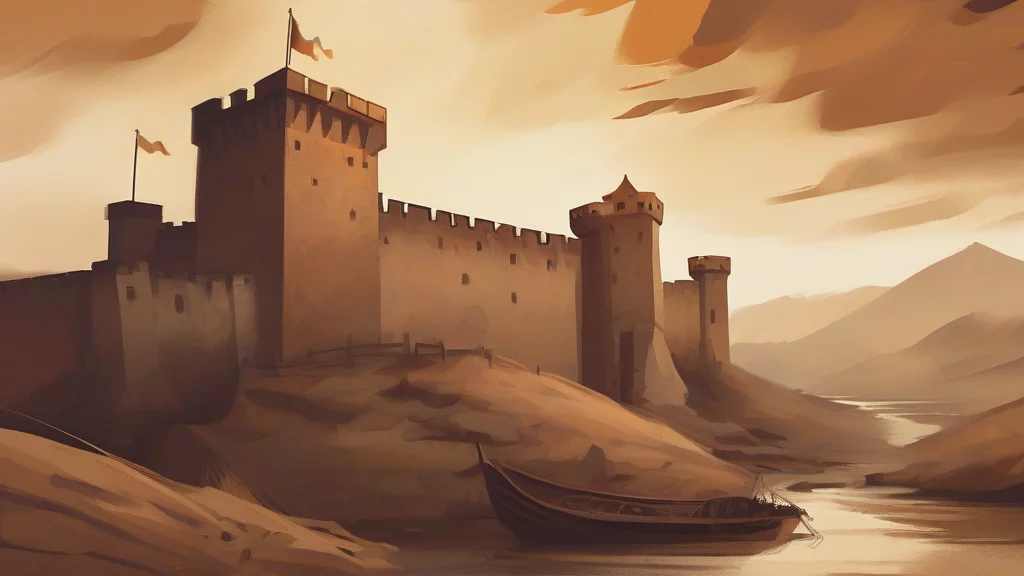
What does fortress mean?
A fortress is a massive, strongly built structure designed to withstand attack, whether a mediaeval castle crowning a hilltop or a star-shaped bastion guarding a frontier. Derived from the Latin 'fortis,' meaning strong, the word entered English in the early fifteenth century by way of Old French and has long served as the definitive term for permanent military strongholds — larger and more enduring than an ordinary fort. Over time its meaning has broadened metaphorically: people speak of a 'mountain fortress,' a 'fortress of solitude,' or a football club's unbeatable home ground, using the word to convey impregnability, security, and resilience. Its connotations are largely positive when describing protection, though it can also imply isolation or an unwillingness to engage with the outside world. Few English words so vividly capture the idea of strength through defence, making 'fortress' both practically useful and richly expressive.
nounA large, strongly built fortification, typically a castle or military stronghold, designed to defend against attack.
- A heavily fortified military or defensive structure, such as a castle or stronghold.
- By extension, anything regarded as strongly protected or difficult to penetrate, such as a 'fortress' of wealth, faith, or a sports team's home ground.
"The medieval fortress loomed above the valley, its stone walls untouched after seven centuries."
"Perched on the clifftop, the ancient fortress commanded views of every approach by land or sea."
"The team's stadium has become a true fortress — they haven't lost a home match in two seasons."
The standard plural simply adds -es, reflecting the word's Latinate spelling; pronounce it /-ɪz/.
"The coastline was once dotted with fortresses guarding against invasion."
"Fortress" comes straight from Latin "fortis" — strong — the same root that gives us the word "comfort," which literally means "to strengthen together."
Reviewed by Deb Chak, Editor. AI-assisted content curated by RJS Tech Solutions LLP.
Etymology of fortress
Fortress originates from the Latin adjective 'fortis,' meaning strong or brave, which passed into Old French as 'fort' and gave rise to 'forteresse.' The word entered English in the early fifteenth century, initially appearing in forms such as 'fourtres' and 'fortalice' before settling into its modern spelling. It shares this Latin root with related terms including 'fort,' 'fortify,' and 'fortitude,' all expressing the core idea of strength.
How fortress is actually used
Fortress is an everyday noun in both British and US English, used both literally for military architecture and figuratively for anything strongly defended. In figurative use it often carries connotations of security and impregnability, though it can also suggest isolation or defensiveness. The term is slightly more evocative and literary than the plainer word 'fort.'
Easily confused with fortress
A fort is a smaller, often temporary military structure, while a fortress is a massive, permanent stronghold capable of withstanding a prolonged siege.