What does fougasse mean?
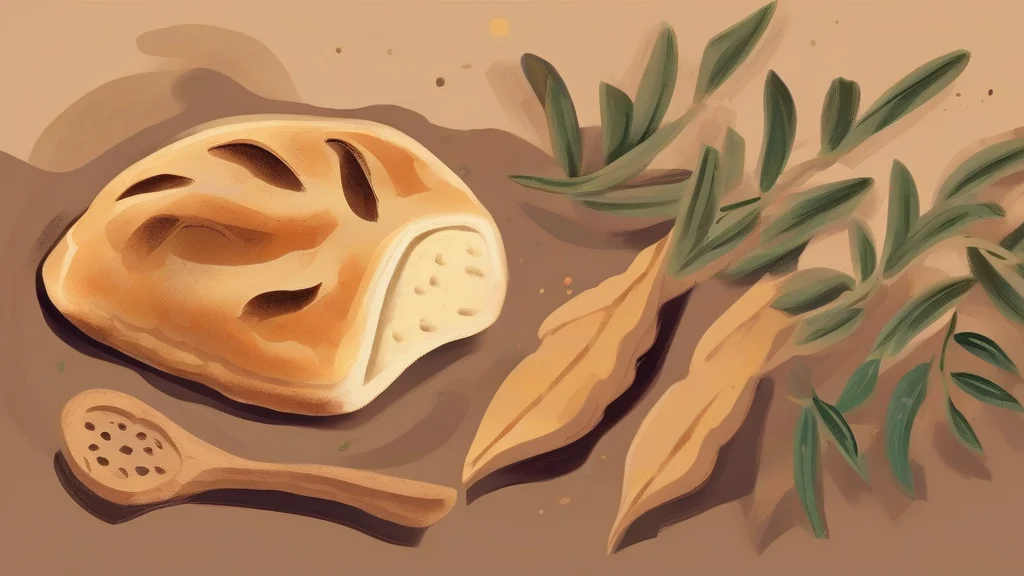
Fougasse is an English noun borrowed from French that carries two strikingly different meanings. Its primary sense is culinary: a flat, crusty bread from Provence, shaped like an ear of wheat or a leaf with slits running through it, commonly studded with black olives, herbs, anchovies, or cheese and baked until golden. It is a close cousin of Italian focaccia and is widely enjoyed as a snack or accompaniment throughout southern France. Its second sense is military: a fougasse is an improvised explosive charge buried in the ground or set into a wall and detonated to destroy roads, block advancing troops, or scatter debris. Both senses descend ultimately from the Latin 'focus' (hearth, fire), reflecting either the hearth oven that bakes the bread or the fire of the buried charge. Today the word appears chiefly in cookery writing and menus, while the explosive sense survives mainly in historical and military literature.
A flat, slatted or leaf-shaped bread from Provence, similar to focaccia, typically flavoured with olives, herbs, anchovies, or cheese.
"The market stall displayed golden fougasses flecked with black olives."
Almost always used in culinary contexts relating to southern French cuisine.
An improvised explosive charge buried in the ground or set into masonry and fired to impede an enemy or demolish an obstacle.
"Engineers cleared a fougasse hidden beneath the bridge approach."
Chiefly historical; found in military history and accounts of siege warfare.
The standard English plural simply adds -s; it applies to both the bread and the explosive sense.
"Two warm fougasses arrived at the table with the morning coffee."
The same word names a beloved French street food and a fearsome buried explosive — both literally trace back to Latin 'focus', meaning fire.
Reviewed by Deb Chak, Editor. AI-assisted content curated by RJS Tech Solutions LLP.
Etymology of fougasse
Fougasse was borrowed from French, where the bread takes its name from Provençal 'fogassa', itself derived from Latin 'focus', meaning hearth or fire — the source also of English 'focus' and Italian 'focaccia'. The military term arose separately but from the same French word, since the buried charge evokes the element of fire at the heart of the etymology; it entered English usage during the early modern period as siege warfare techniques spread across Europe.
How fougasse is actually used
In culinary contexts the word is almost always associated with southern French cuisine and appears frequently on menus and in baking books; plural is 'fougasses'. The military sense is now largely historical, encountered in accounts of fortification and warfare from the early modern period through the World Wars.
Easily confused with fougasse
Focaccia is the Italian bread from which comparison is usually drawn, while fougasse is its distinctively shaped, laddered Provençal counterpart.