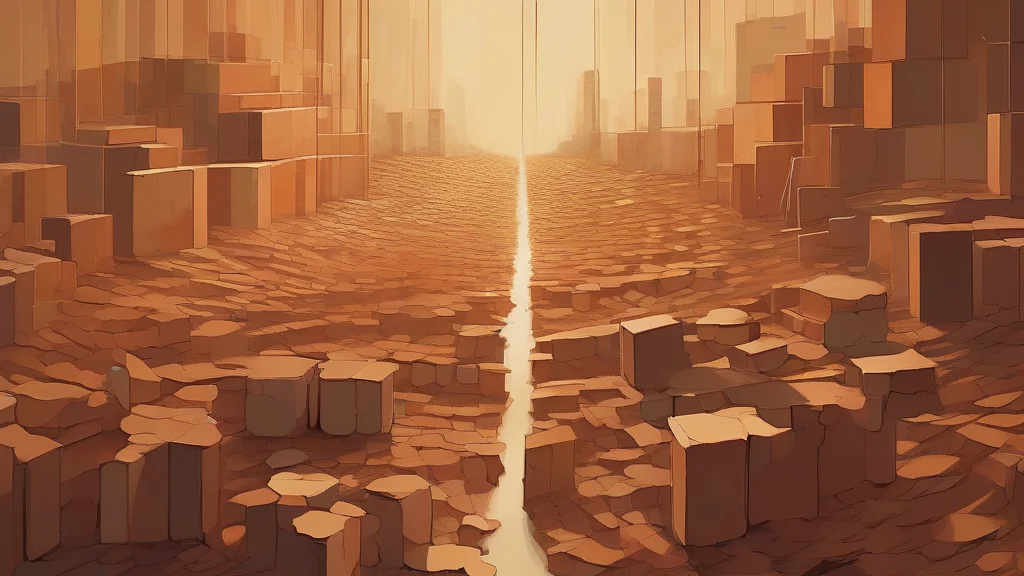
What does fragmentation mean?
Fragmentation is the process, or resulting state, of something breaking into smaller, disconnected parts. It applies equally to physical phenomena — rock shattering, glass splintering — and to abstract ones: societies splitting along ideological lines, markets dividing into countless niches, attention dispersing across endless channels. The word carries predominantly negative connotations, suggesting lost coherence, wasted effort, or weakened unity, whether one speaks of habitat fragmentation isolating wildlife populations or disk fragmentation slowing an aging computer. Derived from the same Latin root as 'fragile', it inherently evokes breakability. Fragmentation is most at home in formal and academic registers — ecology, politics, computing, media studies — yet its meaning is immediately graspable. It is useful precisely because it names not just a single act of breaking but an ongoing condition of division, capturing both event and aftermath in a single term.
nounThe process or result of breaking or being broken into small, separate parts; the state of being divided into fragments.
- The act or process of breaking something into small, disconnected pieces (physical or concrete).
- The division of a society, market, audience, political landscape, or field into smaller competing units (abstract/social).
- In computing and biology, technical senses: storage fragmentation (inefficient scattering of data on disk) and habitat fragmentation (ecosystems split into isolated patches).
"Habitat fragmentation has left wildlife populations isolated in ever-smaller pockets of land."
"Repeated freeze–thaw cycles caused the slow fragmentation of the cliff face into loose scree."
"Critics lament the fragmentation of the modern media landscape, where no shared narrative unites audiences."
Rarely pluralized; fragmentation is usually treated as an uncountable process name. A plural appears mainly when distinguishing multiple distinct instances.
"The report documented several distinct fragmentations within the former Yugoslavia's borders."
Fragment comes from Latin frangere, 'to break' — making 'fragment' a close cousin of 'fragile', which is exactly why fragile things fragment.
Reviewed by Deb Chak, Editor. AI-assisted content curated by RJS Tech Solutions LLP.
Etymology of fragmentation
Fragmentation derives ultimately from the Latin verb frangere ('to break'), via the noun fragmentum ('a broken piece'), from which English took 'fragment'. The derivative form 'fragmentation' arose later, with English usage becoming established around the nineteenth century as scientific vocabulary expanded. It shares this root with cognates such as 'fragile', 'fracture', and 'fraction', all tracing back to that same idea of breaking.
Related word forms
How fragmentation is actually used
Fragmentation is a formal-to-neutral term common across scientific, technological, political, and cultural discourse. It usually carries negative connotations — implying loss of coherence or unity — though in ecology it is simply a neutral descriptive term for how landscapes change.
Easily confused with fragmentation
Fractionalization refers specifically to dividing something into smaller groups or shares, whereas fragmentation describes any breaking into disconnected parts, physical or abstract.