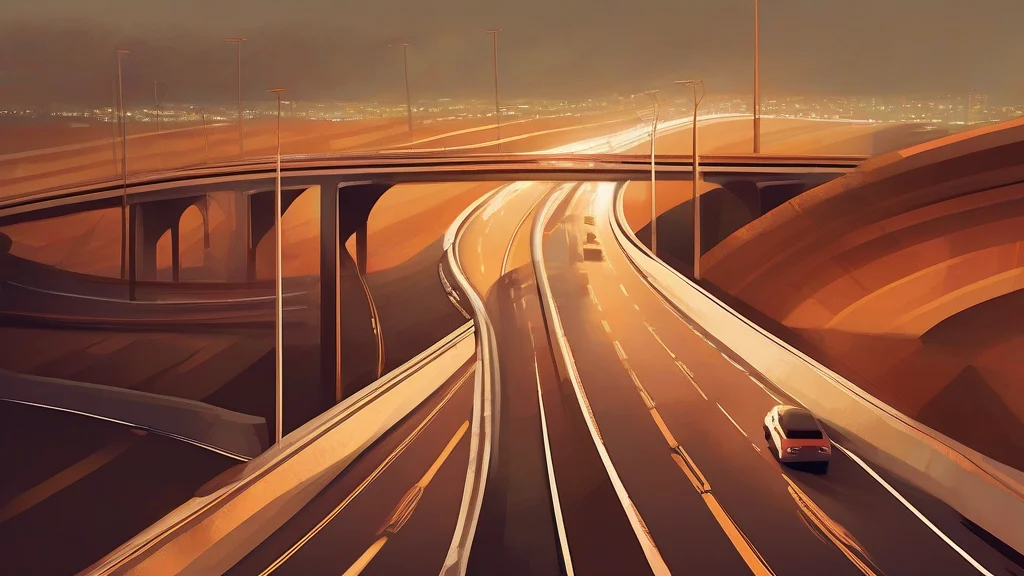
What does freeway mean?
A freeway is a high-capacity road built exclusively for motor vehicles, characterized by multiple lanes in each direction, a dividing median, and carefully controlled access through ramps rather than intersections. Because there are no stoplights, cross streets, or tolls, traffic can flow continuously at higher speeds than on ordinary roads. The word is used mainly in the United States; equivalent roads elsewhere go by names such as motorway (Britain), autoroute (France), or autobahn (Germany), and some American regions prefer expressway or turnpike for comparable roads. Freeways became a defining feature of the American landscape after the Interstate Highway Act of 1956, reshaping cities, suburbs, and daily commutes. In speech and writing, the term often evokes modern mobility and its drawbacks alike — congestion, sprawl, and the iconic multilane interchange. For anyone describing contemporary transportation, especially in an American context, freeway is an essential and precisely meaningful term.
nounA multi-lane divided highway designed for high-speed travel, with controlled access via ramps and no tolls or at-grade intersections.
- A divided, limited-access multilane highway without tolls, built for high-speed long-distance traffic (chiefly US usage).
"We took the freeway downtown to avoid the surface-street traffic."
"Traffic on the 405 freeway slowed to a crawl during rush hour."
"The new freeway cut the drive between the two cities nearly in half."
Standard pluralization applies; 'freeways' refers simply to more than one such highway.
"Southern California is famous for its vast network of freeways."
'Freeway' is a purely American coinage — coined in the 1930s to promise drivers exactly what the name says: a road you could drive on for free.
Reviewed by Deb Chak, Editor. AI-assisted content curated by RJS Tech Solutions LLP.
Etymology of freeway
The word 'freeway' is an American coinage combining 'free' — meaning both without toll and unconstrained — with 'road', emerging among California planners in the 1930s as they proposed toll-free, access-controlled highways. Its first element descends from Old English 'frēo', related to German 'frei' and Dutch 'vrij', from the same Germanic root that gives us 'freedom', 'freelance', and 'freeman'. As automobile infrastructure spread, the term entered everyday American vocabulary, though other English-speaking countries adopted different names such as 'motorway'.
How freeway is actually used
Freeway is primarily an American term; British and many other English speakers use 'motorway', while some US regions favor 'expressway' or 'throughway'. It carries no strong register — it is ordinary everyday speech — but it often evokes modern car culture, commuting, and mid-20th-century urban planning.
Easily confused with freeway
A highway is any major public road, while a freeway is specifically a divided, limited-access highway with no tolls and no cross traffic.
A turnpike (or tollway) requires drivers to pay a toll, whereas travel on a freeway is free of charge.