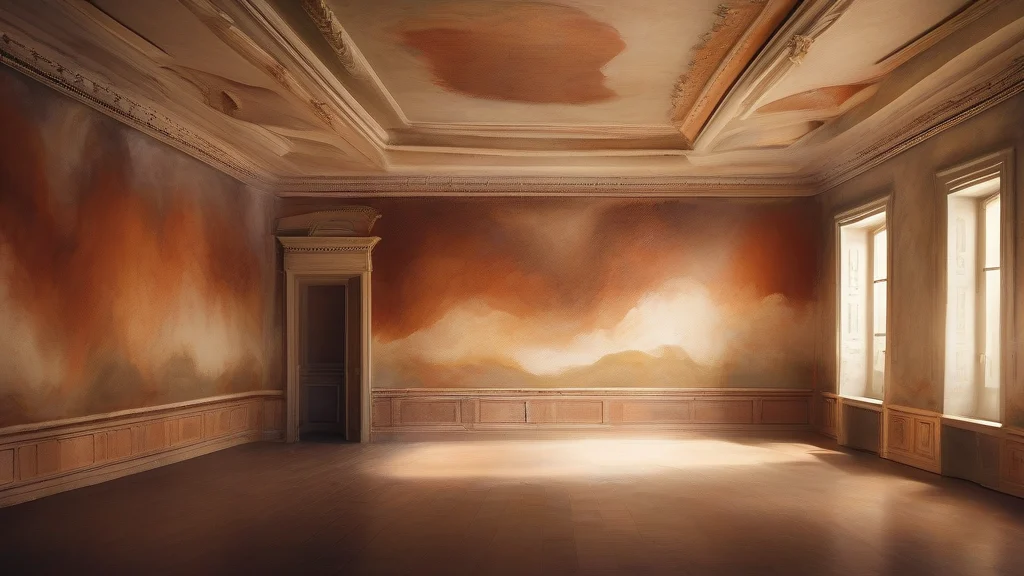
What does frescoed mean?
Frescoed describes a surface — most often a wall, ceiling, or vault — that has been painted in fresco, the ancient technique of applying water-based pigments onto freshly laid, still-wet plaster. As the plaster dries, the paint becomes chemically bonded into the wall itself, producing colors of remarkable durability and luminosity. The adjective appears almost entirely in art-historical, architectural, and travel contexts: one speaks of a frescoed chapel, a frescoed dome, or the frescoed halls of a Renaissance palace. Because the technique flourished in Italy from the medieval period onward, the word carries strong connotations of grandeur, craftsmanship, and European artistic heritage. It is the participial form of the verb 'to fresco', itself borrowed from Italian 'affresco', which ultimately traces back to a Germanic root for 'fresh'. Knowing this word enriches any description of the great painted interiors of the world, from Pompeii's villas to the Sistine Chapel.
adjective (past participle of the verb 'fresco')Painted in fresco — that is, decorated with pigments applied onto wet plaster so the colors become an integral part of the wall or ceiling surface. Used chiefly to describe walls, ceilings, and vaults of buildings, especially churches and palaces.
- (Of a wall, ceiling, or other surface) painted with frescoes; decorated using the fresco technique of applying pigment to wet plaster.
"The chapel's frescoed ceiling draws visitors from around the world."
"The palazzo's frescoed ballroom has remained remarkably vivid since the seventeenth century."
"Visitors craned their necks to admire the frescoed vaults above the nave."
When Michelangelo finished the Sistine Chapel ceiling, he wasn't just painting it — he was literally baking his colors into the plaster itself, which is why we call it 'frescoed' more than four centuries later.
Reviewed by Deb Chak, Editor. AI-assisted content curated by RJS Tech Solutions LLP.
Etymology of frescoed
Frescoed derives from the verb 'to fresco', taken from Italian 'fresco' (as in 'affresco', painting on fresh plaster), which entered English in the sixteenth and seventeenth centuries alongside growing interest in Italian art. The Italian word 'fresco' means 'fresh' and descends from a Germanic root (via Proto-Germanic *friskaz) that also gave English its own word 'fresh' — making 'fresh', 'refresh', and 'afresh' distant cousins of the term. As a past-participle adjective, 'frescoed' follows the same pattern as similar art terms formed from technique verbs.
Related word forms
How frescoed is actually used
Almost exclusively used in art-historical, architectural, and travel-writing contexts; rarely encountered in everyday conversation. It functions as a descriptive adjective derived from the verb 'to fresco', and typically connotes grandeur, antiquity, and Renaissance or classical European artistry. The spelling is usually singular ('a frescoed ceiling'), though the underlying verb form can appear as 'frescoes' or 'frescoing'.
Easily confused with frescoed
'Fresco' is the noun naming the painting technique or artwork itself, while 'frescoed' describes a surface that has been painted using that technique.