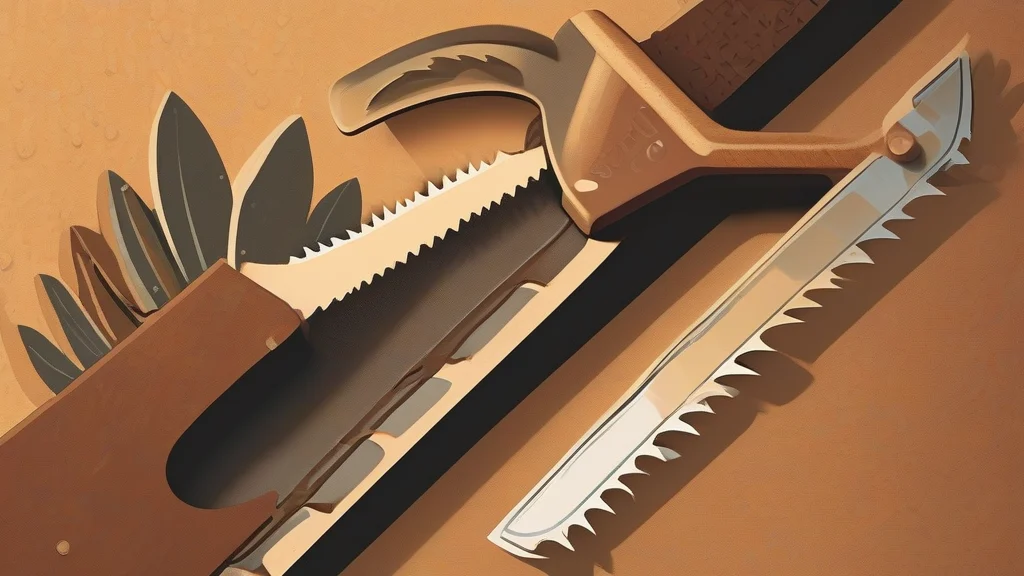
What does fretsaw mean?
A fretsaw is a specialized hand tool consisting of a very fine, replaceable blade stretched taut across a deep, narrow, usually C-shaped metal frame, held under tension by a handle at one end. Its purpose is precision: the hair-thin blade can turn tight corners and follow elaborate curves that coarser saws cannot manage, and it can be passed through a small drilled hole to make interior cutouts without cutting in from the edge. Fretsaws are staples of woodworking, marquetry, model-making, and craft workshops, typically used on thin plywood, veneer, or soft metals. The name reflects its association with 'fretwork' — decorative openwork patterns of interlaced design. Though less commonly discussed than powered equivalents such as the jigsaw or scroll saw, the fretsaw remains valued wherever delicacy and control matter more than speed, and the term itself signals a tradition of patient, detailed handcraft.
nounA fretsaw is a hand saw with a fine blade stretched in a deep, narrow C-shaped frame, designed for cutting intricate curved patterns and openings in thin wood, plastic, or metal sheet.
- A hand saw with a fine blade held in tension by a long, narrow frame, used for making intricate curved cuts and pierced patterns in thin material such as plywood, veneer, or soft metal.
"Using a fretsaw, she cut an elaborate floral pattern into the thin plywood panel."
"He threaded the fretsaw blade through a drilled hole to cut out the latticed center of the ornament."
"Model makers often reach for a fretsaw when a design calls for curves too tight for any power tool."
A regular plural; typically refers to multiple tools rather than multiple blades, since replacement blades are usually described simply as 'blades'.
"The workshop kept several fretsaws on hand, each fitted with a different grade of blade."
Its blade is so delicate that it snaps if you look at it wrong — yet the fretsaw can cut shapes no power saw can trace.
Reviewed by Deb Chak, Editor. AI-assisted content curated by RJS Tech Solutions LLP.
Etymology of fretsaw
The word fretsaw combines 'saw' with 'fret', a term drawn from decorative openwork patterning known as fretwork, whose origins lie in Old French 'frete', describing interlaced ornamental designs. The name thus ties the tool directly to the pierced, lattice-like decoration it was made to produce. It emerged in the vocabulary of English-speaking woodworkers during the nineteenth-century heyday of amateur fretwork as a popular pastime. Related descendants of the same 'fret' lineage include 'fretwork' itself and the 'fretted' surfaces and patterns found across the decorative arts.
How fretsaw is actually used
The word carries a craft-workshop connotation and appears mainly in woodworking, marquetry, model-making, and hobby contexts rather than everyday conversation. It is more strongly associated with British usage than American, where terms like 'scroll saw' or 'jeweler's saw' are often substituted depending on context.
Easily confused with fretsaw
A coping saw has a shallower frame and slightly coarser blade suited to cutting moldings and joints, while a fretsaw's much deeper frame and finer blade allow tighter curves and interior cutouts.
A jigsaw is a powered reciprocating tool, whereas a fretsaw is a manually operated framed saw with a far thinner blade.