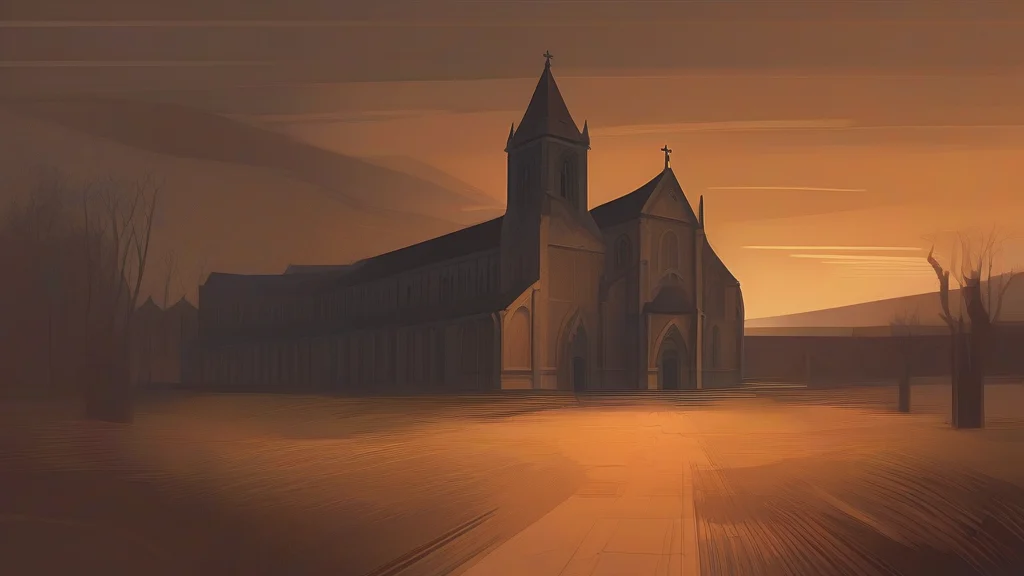
What does friary mean?
A friary is a building, or group of buildings, serving as the home of a community of friars — members of mendicant religious orders such as the Franciscans, Dominicans, Augustinians, and Carmelites. The term parallels the monastery for monks and the convent for nuns, though friaries differ in spirit: because friars took vows of poverty and devoted themselves to preaching, teaching, and charitable work among ordinary people, their houses were typically established in or near towns rather than in isolated countryside settings. The word derives ultimately from Latin frater, meaning 'brother', reflecting the fraternal ideal at the heart of these communities. In Britain especially, 'friary' is a familiar term in historical and archaeological contexts, as Henry VIII's dissolution of the monasteries in the 1530s left the ruins of numerous medieval friaries scattered through city centres. Today the word appears chiefly in religious writing, heritage tourism, and scholarly discussion of medieval architecture.
nounA friary is a building or complex that houses a community of friars — members of a mendicant religious order such as the Franciscans, Dominicans, or Augustinians. It functions as a residence and base for their religious work, analogous to a monastery for monks.
- A building or residence occupied by a community of friars of a mendicant religious order.
"The medieval friary at the edge of town still shelters a small community of Franciscan brothers."
"Archaeologists uncovered the stone foundations of a thirteenth-century Dominican friary beneath the car park."
"After taking his final vows, Brother Thomas was assigned to the Franciscan friary in Assisi."
Standard plural; irregular spellings do not occur.
"Several Dominican friaries were founded across England during the thirteenth century."
Unlike monks who stayed behind cloister walls, friars lived and preached in the streets — so their friaries were built right inside growing medieval cities, not on remote hilltops.
Reviewed by Deb Chak, Editor. AI-assisted content curated by RJS Tech Solutions LLP.
Etymology of friary
The word 'friary' comes from 'friar', which entered Middle English from Old French 'frere' ('brother'), itself derived from Latin frater, meaning 'brother'. The term reflects the self-understanding of the mendicant orders that emerged in the early thirteenth century, whose members styled themselves as brothers to all. The suffix '-ary', denoting a place associated with something, produced a word parallel to 'monastery' and 'armoury'. Related words sharing the Latin root include 'fraternal', 'fraternity', and 'confraternity'.
How friary is actually used
The word carries an ecclesiastical, somewhat formal register and appears most often in historical, architectural, or religious contexts. In modern British usage it frequently surfaces in archaeology and heritage reporting, since many English towns grew around former friaries dissolved under Henry VIII. The plural is 'friaries'.
Easily confused with friary
A monastery houses monks (members of a contemplative order who remain within its walls), while a friary houses friars, who belong to mendicant orders and traditionally work out among the public.
A convent most often refers to a residence for nuns (or sometimes for friars in older British usage), whereas a friary specifically houses male friars.
A priory is a house of either monks or friars that is subordinate to an abbey or larger house; 'friary' refers specifically to a house of friars regardless of rank.