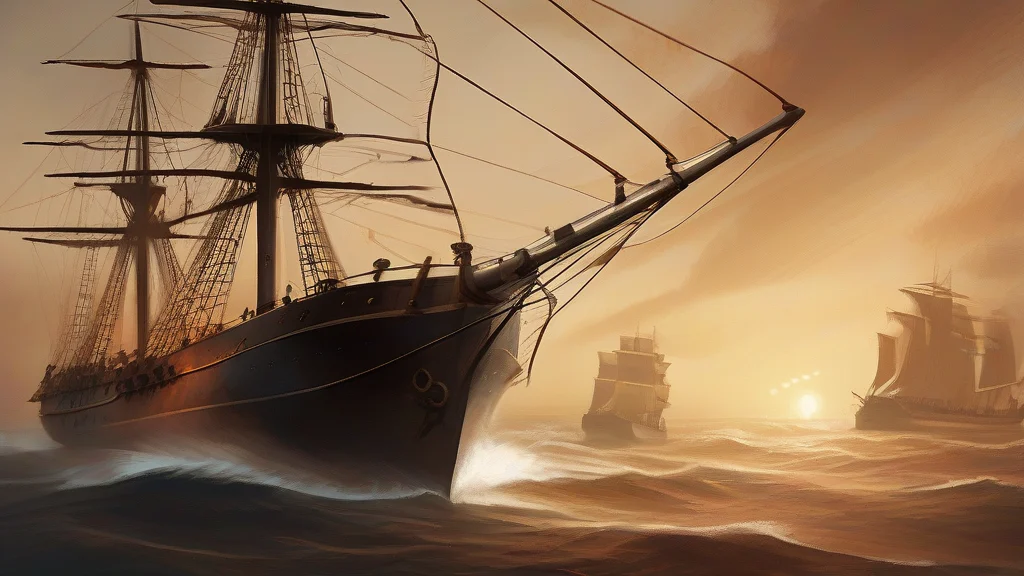
What does frigate mean?
A frigate is a warship occupying a middle rank in a navy's fleet: faster and lighter than a ship of the line or a large destroyer, but heavily armed enough to fight, screen, and protect. In the age of sail, from roughly the seventeenth through the mid-nineteenth century, frigates were the swift eyes of the fleet — sent ahead to scout, carrying dispatches, raiding enemy commerce, and escorting merchant convoys, often operating far from home ports without support. The term survived the transition to steam and steel, and today a frigate typically denotes a modern escort warship, usually smaller than a destroyer, tasked with anti-submarine, anti-aircraft, and convoy-protection duties. The word carries strong connotations of speed, independence, and dashing seamanship; the romantic figure of the lone frigate captain on distant stations remains a staple of naval fiction. Beyond warships, the name also belongs to the frigatebird, a seabird named for the vessel's swiftness. For anyone reading naval history, following maritime news, or enjoying seafaring fiction, 'frigate' is an essential and evocative term.
A fast, medium-sized warship: historically, a square-rigged sailing vessel armed with a single gun deck and used for scouting, patrolling, and escorting; in modern navies, an escort warship, generally smaller than a destroyer, used to protect convoys and fleets, especially against submarines and aircraft.
"The frigate shadowed the suspicious vessel for hours before boarding parties were sent across."
In naval usage, 'frigate' refers to two distinct ship types separated by era: the classic sailing frigate of the 18th–19th centuries and the modern steam- or gas-turbine-powered escort. Historical fiction and naval history usually invoke the former; contemporary defense journalism the latter.
(Historical) A light, fast sailing vessel of the 17th and early 18th centuries, often fitted with oars as well as sails, used in the Mediterranean and elsewhere for trading, privateering, and scouting.
"The corsairs slipped out of the harbor in their frigates, relying on oars to escape the calm that becalmed their pursuers."
Standard plural; used both for multiple warships in a fleet or class and, in ornithology, collectively for frigatebirds.
"Three frigates of the Royal Navy anchored in the harbor for the fleet review."
Even etymologists can't fully explain where 'frigate' comes from — the word sailed into English from French and Italian, but its ultimate origin remains a mystery.
Reviewed by Deb Chak, Editor. AI-assisted content curated by RJS Tech Solutions LLP.
Etymology of frigate
The word 'frigate' entered English in the early seventeenth century from French 'frégate', which itself came from Italian 'fregata', a term for a light, fast vessel used in Mediterranean warfare. Despite centuries of scholarly attention, the ultimate origin of the Italian word remains uncertain, though it has been linked speculatively to Mediterranean and Romance sources. From its original sense of a small, fast oared-and-sailed craft, the meaning shifted as naval architecture evolved, settling by the eighteenth century on the familiar square-rigged sailing warship, and later transferring to its modern steel-hulled descendants. Related forms such as French 'frégate' persist across the Romance languages.
Related word forms
How frigate is actually used
'Frigate' is an almost entirely nautical/military term with formal-to-neutral register; it appears mainly in naval, historical, and journalistic contexts. In ordinary conversation it arises mostly through news about navies or interest in maritime history. Note that 'frigate' also names a family of seabirds (frigatebirds), which were themselves named after the warship.