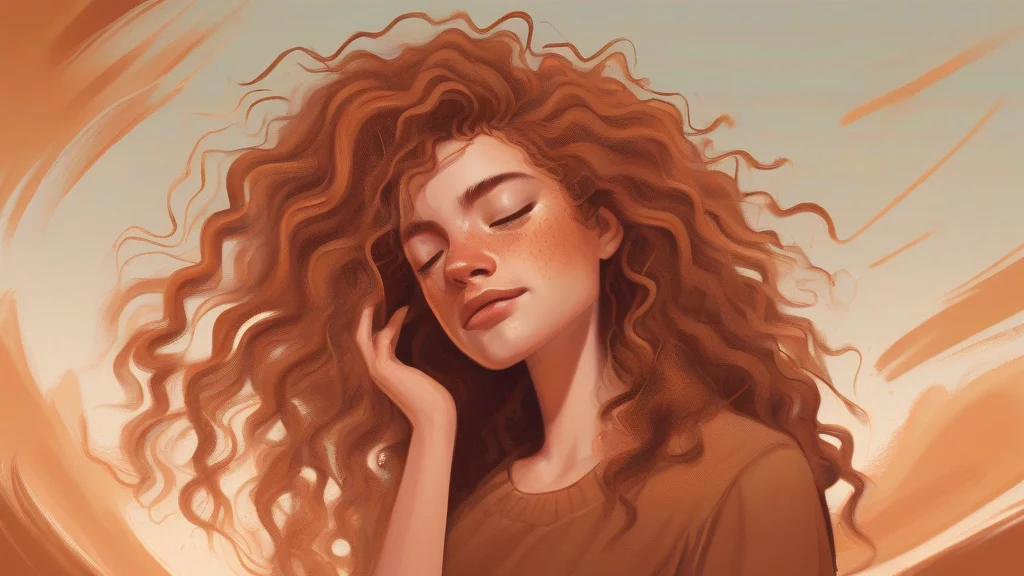
What does frizzy mean?
Frizzy describes hair — and occasionally fabric or fibres — that forms many small, tight curls, giving it a dry, puffy, unruly appearance. It is most often used of human hair, especially when humidity, damage, or natural texture causes smooth strands to break into fine corkscrews and flyaways. The word derives from the older verb 'frizz', meaning to curl hair tightly, which itself traces to a French root for curling, so the adjective has been bound up with hairstyling from the start. In everyday speech 'frizzy hair' is such a fixed pairing that the adjective rarely appears elsewhere, though it can describe worn carpet, crinkled thread, or frayed cloth edges. Connotations are mixed: traditionally frizz implied untidiness and something to be smoothed away, but contemporary attitudes toward natural curl patterns have made the term more descriptive than critical. It remains one of the most widely recognised words for describing textured hair.
(Of hair) forming many small tight curls; dry, puffy, and hard to smooth.
"Her frizzy hair defied every brush she owned."
Used almost exclusively of hair; extended use for fibres or fabric is uncommon.
Having a finely crinkled or curled texture, as of yarn, fabric, or fibres.
"The sweater's frizzy fibres gave it a soft, fuzzy look."
The word 'frizzy' comes straight from 'frizz' — an old verb for curling hair with hot irons — so every bad-hair day owes its name to the styling tools that started it.
Reviewed by Deb Chak, Editor. AI-assisted content curated by RJS Tech Solutions LLP.
Etymology of frizzy
Frizzy derives from the verb 'frizz', meaning to fry or, in hairdressing, to curl into small tight ringlets, first recorded in English around the early 17th century. The verb itself is usually traced to the French 'friser', meaning to curl or crisping hair, a word whose own origins lie in the Romance family. From 'frizz' came the related form 'frizzle', and the adjective 'frizzy' emerged as a straightforward derivation of that curling sense. Its French cousins survive in hairstyling vocabulary such as 'frisure' (a curl or curled hairstyle) and 'frisette' (a side curl or false lock).
How frizzy is actually used
Almost always used attributively before 'hair'. The term is neutral in itself, but in beauty contexts it often carries a mildly negative connotation, since frizz is typically something people try to control or eliminate; natural-hair movements have pushed back on that framing, celebrating frizz as a normal feature of curly textures.
Easily confused with frizzy
Fizzy describes a liquid full of carbon-dioxide bubbles, while frizzy describes hair that is tightly curled or unruly.