What does frogfish mean?
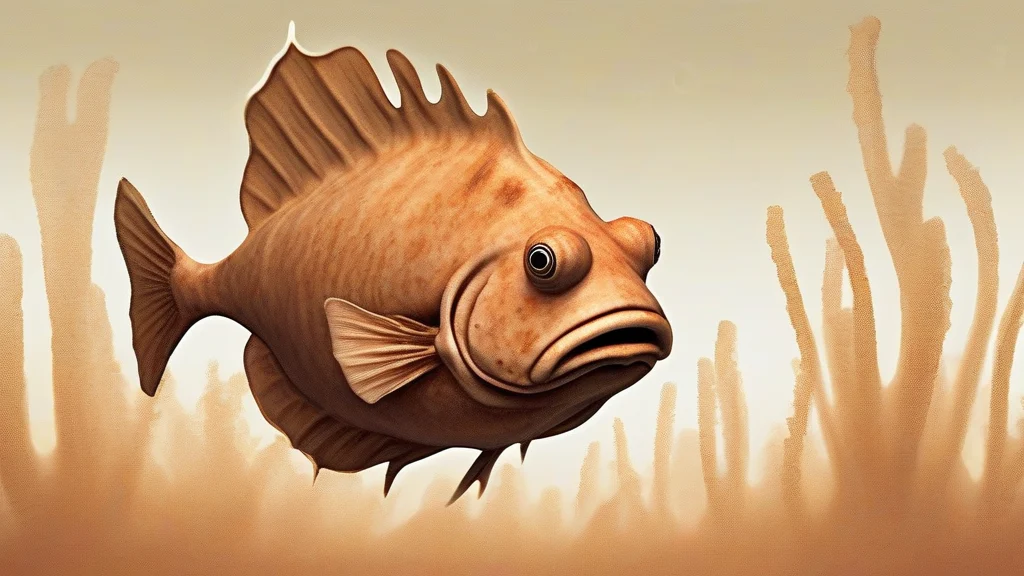
The frogfish is any of a family (Antennariidae) of small, stocky marine fishes found in tropical and subtropical oceans, prized by divers for their extraordinary camouflage and bizarre appearance. Rather than chasing food, a frogfish is an ambush predator: it rests motionless among sponges and coral, blending in through shape-shifting skin appendages and coloration, and waves a modified dorsal spine — the illicium — tipped with a fleshy bait-like lure above its mouth. When prey ventures close, the frogfish strikes with astonishing speed, engulfing it in milliseconds, and can expand its stomach to swallow animals approaching its own size. Its name reflects its frog-like look: a rounded body and pectoral fins adapted like legs for 'walking' along the seafloor. The word appears chiefly in marine biology, diving literature, and nature writing, making it a specialist term worth knowing for anyone interested in ocean life.
nounA small, squat-bodied marine fish of the family Antennariidae, related to anglerfishes, that uses a modified dorsal fin spine as a lure to attract prey and often walks along the seabed on leg-like fins.
- Any of various small, sedentary marine fishes of the family Antennariidae, characterized by a globular body, leg-like pectoral fins, and a lure (illicium) used to attract prey.
"The warty frogfish blended so perfectly into the sponge-covered reef that the diver nearly missed it entirely."
"A giant frogfish can swell its stomach to swallow prey nearly as large as itself."
"Underwater photographers travel to Lembeh Strait hoping to photograph a hairy frogfish in the wild."
Both plurals are accepted; "frogfish" follows the common convention of unchanged plurals for many fish names, while "frogfishes" is preferred when distinguishing multiple species or individuals.
"The reef supports several frogfishes, from tiny juvenile warty frogfish to a full-grown giant."
The frogfish doesn't swim after dinner — it dangles a tiny fleshy 'fishing rod' from its head, then gulps down prey in as little as six milliseconds, one of the fastest strikes in the animal kingdom.
Reviewed by Deb Chak, Editor. AI-assisted content curated by RJS Tech Solutions LLP.
Etymology of frogfish
The name frogfish is a straightforward English compound of "frog" and "fish," coined because these fishes resemble frogs in their squat bodies and hopping, leg-like movement across the seabed. Such compound names were commonly formed by naturalists in early modern English to describe unfamiliar creatures by analogy with familiar ones. The element "frog" traces back to Old English "frogga," of uncertain ultimate origin, while "fish" derives from Old English "fisc," common to Germanic languages.
How frogfish is actually used
"Frogfish" is primarily a technical and naturalist term, most common in marine biology, diving, and aquarium contexts rather than everyday conversation. It refers collectively to members of the family Antennariidae and is frequently used with common-name modifiers such as "warty," "giant," or "hairy." The plural is usually "frogfish" but "frogfishes" is also accepted when referring to multiple individuals or species.
Easily confused with frogfish
A dogfish is a small shark, whereas a frogfish is a ray-finned anglerfish that lures prey rather than actively hunting it.
A toadfish is a bottom-dwelling coastal fish known for its humming call, while a frogfish is a reef-dwelling ambush predator in the anglerfish family.