What does frogmouth mean?
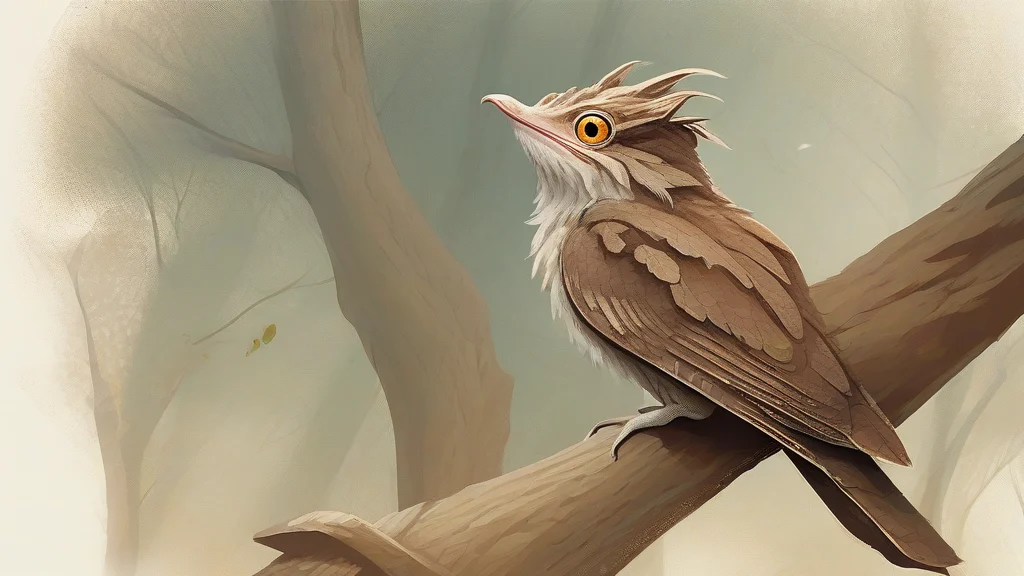
A frogmouth is a nocturnal bird belonging to the family Podargidae, a group of roughly a dozen species found across Australia, Southeast Asia, and the Indian subcontinent. Named for its unusually broad, flat beak and enormous frog-like gape, the frogmouth has soft, mottled grey-brown plumage that renders it nearly invisible against tree bark — a camouflage it reinforces by freezing upright to mimic a broken branch. Its large forward-facing eyes and silent, nocturnal habits mean it is often mistaken for an owl, although it is actually more closely related to nightjars. Rather than chasing prey on the wing, frogmouths typically perch quietly and swoop down on insects, spiders, and small vertebrates. The best-known member, Australia's tawny frogmouth, has become a beloved icon of Australian bushland and urban gardens alike. The word appears chiefly in ornithology, nature writing, and wildlife tourism, where it identifies a distinctive and much-photographed group of birds.
nounA frogmouth is any of various nocturnal birds of the family Podargidae, native to Australia, Southeast Asia, and the Indian subcontinent, characterized by a wide, frog-like gape, large eyes, and cryptic plumage that resembles tree bark.
- Any nocturnal bird of the family Podargidae, found in Australia, Southeast Asia, and the Indian subcontinent, having a wide frog-like mouth, short weak legs, and mottled bark-like plumage.
"The tawny frogmouth sat motionless on its branch, so perfectly camouflaged that we mistook it for a broken limb."
"A pair of tawny frogmouths raised a single fluffy chick in the silver wattle outside our kitchen window."
"Unlike most nocturnal hunters, the frogmouth prefers to swoop down on prey such as insects and small vertebrates from a stationary perch rather than pursuing it in flight."
Standard regular plural; used both for multiple individuals and, collectively, for members of different species within the family.
"Several frogmouths roosted along the creek line, each blending seamlessly into the branches."
Despite the name, the tawny frogmouth isn't an owl — and when threatened, it freezes with beak pointed skyward to impersonate a broken tree branch so convincingly that people can walk right past one.
Reviewed by Deb Chak, Editor. AI-assisted content curated by RJS Tech Solutions LLP.
Etymology of frogmouth
The word "frogmouth" is a transparent English compound formed from "frog" and "mouth," coined to describe the bird's remarkably wide, gaping jaws reminiscent of a frog's. It arose in English natural-history writing around the late eighteenth century, when European naturalists were cataloguing the unfamiliar fauna of Australia and Asia, and it translates the scientific family name Podargidae into everyday language. The component "frog" derives from Old English "frogga," while "mouth" comes from Old English "mūþ," making this a purely Germanic-rooted vernacular compound rather than a classical borrowing.
How frogmouth is actually used
"Frogmouth" is an ornithological term used mainly in birding, natural-history writing, and wildlife discourse; it carries no strong register constraints but is uncommon in everyday conversation. The best-known species, the tawny frogmouth (Podargus strigoides) of Australia, is what many people mean by the word, though roughly a dozen species exist across the family. Because of their owl-like appearance, frogmouths are popularly mislabelled as owls, so careful writers specify the family distinction.
Easily confused with frogmouth
Frogmouths are frequently mistaken for owls because of their nocturnal habits and forward-facing eyes, but they belong to the family Podargidae and are more closely related to nightjars than to true owls.
Nightjars are close relatives in the same order (Caprimulgiformes), but they have smaller gapes, longer wings, and typically hunt insects in flight rather than sallying from perches like frogmouths.