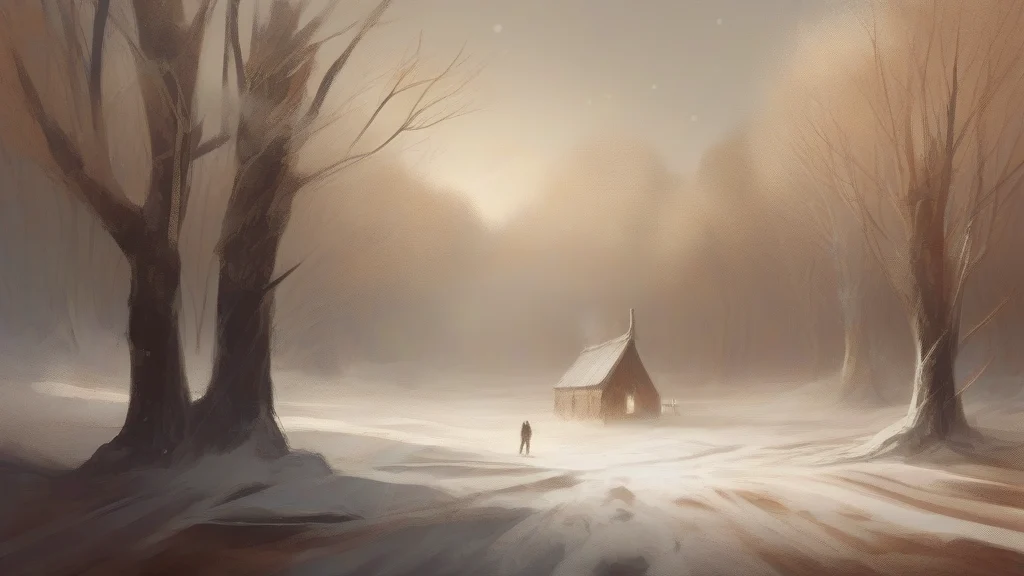
What does frore mean?
'Frore' means frozen — hardened by cold or coated with frost. It is an archaic word with roots deep in Old English, derived ultimately from the same Germanic root that gave us the verb 'to freeze'. Though it has largely vanished from everyday speech, 'frore' survives in literary and poetic contexts, where its antique flavor evokes the stark stillness of deep winter. A line such as 'the frore lake gleamed under the moon' carries a resonance that the plain word 'frozen' cannot quite match, which is precisely why poets from Shakespeare onward kept it alive. Because it is unfamiliar to most modern readers, it works best when its meaning can be inferred from context — describing icy landscapes, frozen ground, or figuratively chilled hearts. For lovers of language, 'frore' is a small linguistic fossil: proof that even ordinary ideas like being frozen once wore richer, stranger clothing in English.
adjectiveFrozen; covered with frost. An archaic and literary word describing something made intensely cold or solidified by freezing.
- Frozen over; hardened or coated with frost.
- Made extremely cold (used figuratively in literature).
"The frore pond lay silent beneath a pale January sky."
"The climbers pressed on across the frore slope, boots crunching on ancient ice."
"Winter's breath had left every hedgerow frore and glittering at dawn."
Shakespeare reached for 'frore' in Hamlet — one of the last gasps of an Old English word for 'frozen' that otherwise lost out to its own root verb.
Reviewed by Deb Chak, Editor. AI-assisted content curated by RJS Tech Solutions LLP.
Etymology of frore
'Frore' descends from Old English 'froren', the past-participle form of 'freosan', meaning to freeze. The same Germanic root produced both the verb 'freeze' and the noun 'frost', making 'frore' essentially an ancient sibling of those familiar words rather than an unrelated term. Its survival into modern English owes much to poets, notably Shakespeare, who used it to evoke intense cold. Outside literary usage it faded away as 'frozen', the natural participle of the still-flourishing verb 'freeze', became the standard form.
How frore is actually used
'Frore' is archaic and survives almost exclusively in poetry and literary prose, where it lends an antique, wintry tone. Writers today would normally use 'frozen'; 'frore' is chosen deliberately for its atmosphere rather than clarity, so it should be used sparingly and with awareness that many readers will not know it.