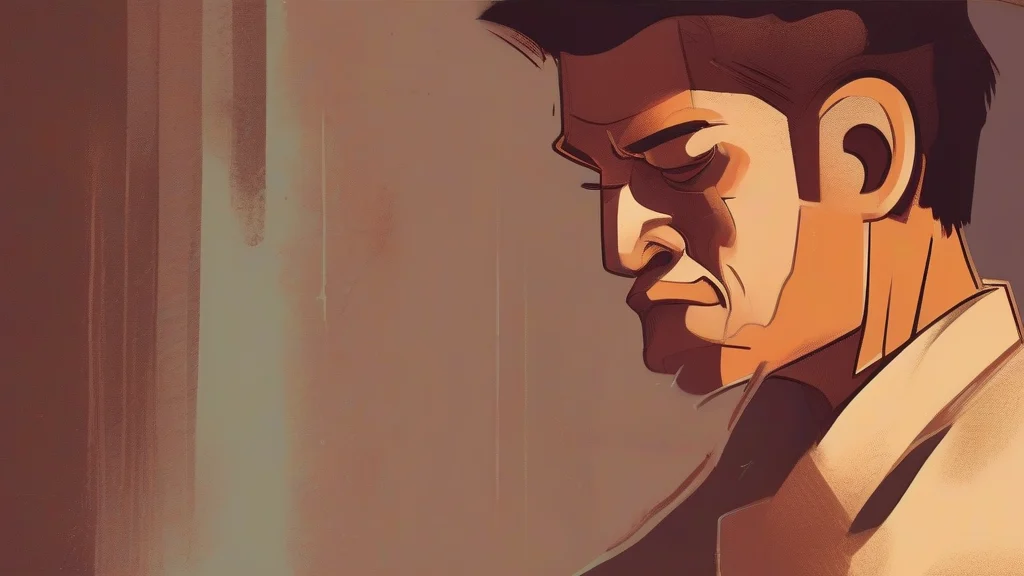
What does frown mean?
Frown is both a verb and a noun describing one of the most universally recognized human expressions: the drawing together and lowering of the eyebrows, often accompanied by tightening around the mouth, that signals displeasure, disapproval, doubt, or intense concentration. As a verb it can describe the physical act itself or, more abstractly, an attitude of censure — to 'frown upon' something is to view it unfavorably, a usage common in formal contexts such as etiquette guides and policy statements. The expression is culturally complex: while typically negative, a frown can equally signal thoughtfulness rather than anger. The word entered Middle English from Old French, ultimately tracing back through Latin words for 'brow', which is why related Romance languages use cognates built on the same root. Its brevity and clarity make it one of the most frequently used expressions of judgment in English.
A facial expression of displeasure, disapproval, or concentration formed by contracting the brows.
"A deep frown crossed her face as she read the letter."
To draw the brows together in displeasure, disapproval, or concentration.
"The teacher frowned at the noise coming from the back row."
Often followed by 'at' or 'on/upon' to indicate the object of disapproval.
Standard pluralization; used when referring to multiple instances of the expression across people or occasions.
"The board exchanged worried frowns as the losses mounted."
Reviewed by Deb Chak, Editor. AI-assisted content curated by RJS Tech Solutions LLP.
Etymology of frown
Frown derives from Middle English, borrowed from Old French forms meaning 'to knit the brow', which themselves trace back to Late Latin terms relating to the forehead and brow (Latin frons, frontis). Related cognates include modern French froncer and Spanish fruncir. It has been used in English since at least the medieval period.
How frown is actually used
Commonly used figuratively to mean to disapprove of ('frown upon'), especially in formal writing. The noun form is frequent but secondary to the verb.
Easily confused with frown
A clown is a comic performer; 'frown' is a facial expression — they share no etymology despite similar sound.