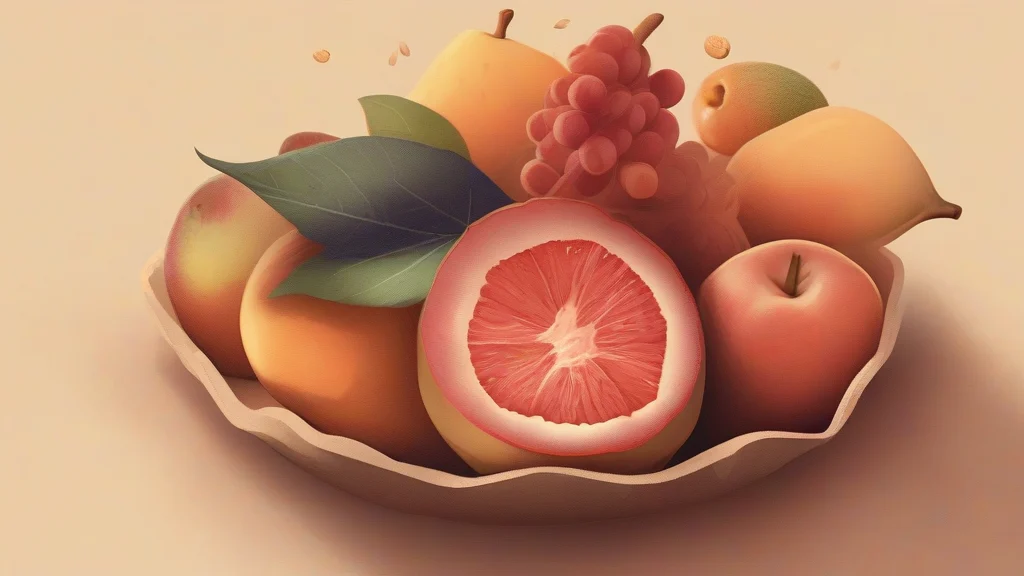
What does fruit mean?
Fruit is the sweet or tart, often juicy product of a flowering plant, formed from its ovary and bearing seeds within flesh that invites animals to eat it and scatter those seeds. In everyday language, fruit means the familiar edible produce of trees, bushes, and vines — apples, berries, mangoes, grapes — eaten fresh or used in cooking, juice, and preserves. Botanists use the word far more broadly: any mature ovary counts, which makes tomatoes, cucumbers, and almonds fruits despite their place on the dinner table as vegetables. Beyond the orchard, the word carries rich figurative weight: labor bears fruit when effort finally succeeds, and the 'fruits of the earth' evoke abundance and reward. Derived forms such as fruitful, fruitless, fruity, and fruition extend this metaphor into ordinary speech. Few words link biology, cuisine, and human ambition so neatly in a single syllable-bearing bite.
The sweet, fleshy, seed-bearing product of a tree, bush, or other flowering plant, especially when eaten as food.
"The orchard's fruit ripened early this year."
Usually uncountable when referring to fruit generally ('buy some fruit') but countable for individual kinds ('a peach, two plums').
(Of a plant) to produce fruit; to bear fruit.
"The apple trees fruit best in full sunlight."
A technical horticultural usage, less common than the noun sense.
'Fruit' is most often treated as an uncountable noun in British usage ('eat plenty of fruit'); American usage also commonly uses 'fruits'. The plural 'fruits' appears mainly in figurative expressions such as 'the fruits of one's labor' or in botanical writing about different kinds of fruit.
"The market stalls were piled high with fruit of every kind."
By the strict botanical definition, a tomato, a cucumber, and even an almond are all fruits — it's only in the kitchen that we decide otherwise.
Reviewed by Deb Chak, Editor. AI-assisted content curated by RJS Tech Solutions LLP.
Etymology of fruit
The word fruit comes from the Old French 'fruit' or 'fruitz', derived ultimately from the Latin noun 'fructus', meaning enjoyment, produce, or yield, itself rooted in the verb 'frui' — to enjoy or take pleasure in. It entered English in the medieval period through Anglo-Norman French. The same Latin root gives English fructose, fructify, fruitful, and fruition, all preserving the ancient association between harvest and enjoyment.
Related word forms
How fruit is actually used
Fruit is a common noun used both collectively (as an uncountable mass: 'eat more fruit') and countably ('two apples, three pears'); the plural 'fruits' survives chiefly in figurative or botanical contexts. In botany the term is broader than everyday use, covering tomatoes, peppers, and grains, so the culinary and scientific senses frequently diverge.
Easily confused with fruit
Botanically many 'vegetables' like tomatoes and cucumbers are fruits, but culinarily 'fruit' refers to sweet, usually raw-eaten plant foods while 'vegetable' refers to savory plant parts.