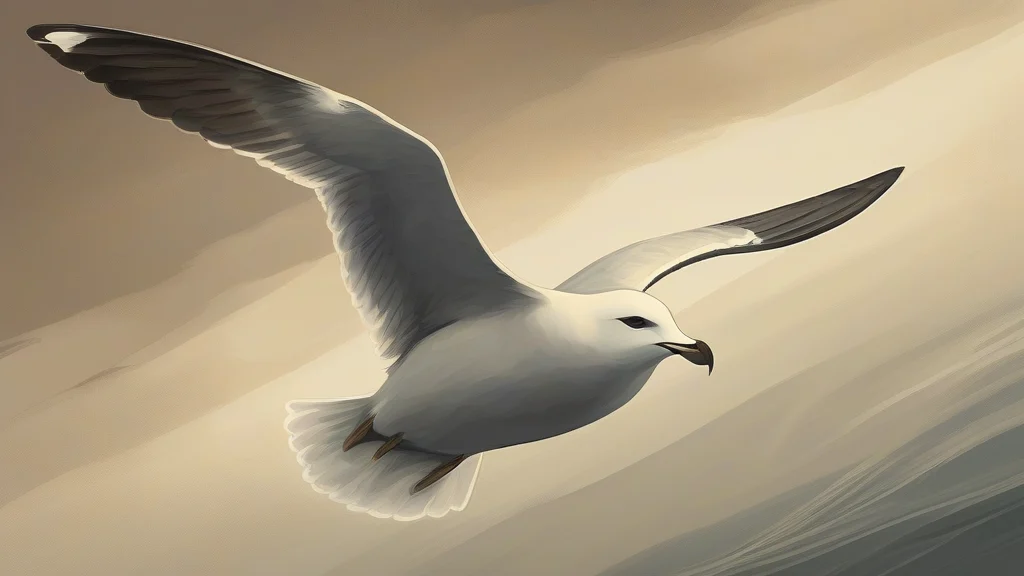
What does fulmar mean?
The fulmar is a northern seabird belonging to the petrel family Procellariidae, named for the genus Fulmarus, which includes the widespread northern fulmar of the North Atlantic and North Pacific. Although superficially gull-like in appearance — grey-backed and white-bodied, with a strong, hooked bill — it is distinguished by its tube-shaped nostrils, a hallmark of petrels, and by its characteristically stiff-winged, soaring flight as it rides the wind above ocean swells and coastal cliffs. The name derives from Old Norse, combining 'fúl' (foul) and 'máfur' (gull), a reference to the bird's habit of defensively projecting foul-smelling stomach oil at intruders near its nest. Fulmars are colonial cliff-nesters across subarctic and Arctic coasts, feeding largely on fish, squid, and offal at sea. The word appears chiefly in ornithological writing, field guides, and the accounts of birdwatchers and sailors.
nounA large, gull-like northern seabird of the petrel family (genus Fulmarus), typically grey and white in plumage, known for its stiff-winged gliding flight and its habit of nesting on sea cliffs.
- A gull-like northern seabird of the petrel family, genus Fulmarus, that nests on sea cliffs.
"From the cliff top we watched fulmars gliding effortlessly along the updraughts above the waves."
"Thousands of fulmars nest along the rugged cliffs of Shetland each summer."
"The birders identified a northern fulmar by its stiff-winged glide just above the swell."
Standard pluralization; commonly used when describing colonial nesting sites or birds seen in groups at sea.
"Hundreds of fulmars crowded the narrow ledges of the sea cliff."
The fulmar earned its name from Old Norse for 'foul gull' — because when threatened, it defends its nest by spraying a foul-smelling oil at intruders.
Reviewed by Deb Chak, Editor. AI-assisted content curated by RJS Tech Solutions LLP.
Etymology of fulmar
The word 'fulmar' entered English in the seventeenth century from Old Norse, whose speakers encountered these abundant seabirds around Iceland and Scandinavia. It combines 'fúl', meaning foul or filthy, with 'mávar'/'már', meaning gull, reflecting early observers' view of the bird as a gull-like creature with disagreeable habits — notably its oily, malodorous defensive spray. The same Norse root 'fúl' underlies related English words such as 'foul'.
How fulmar is actually used
A specialized term used mainly in ornithology, birdwatching, and coastal contexts; in general conversation it carries no figurative or connotative meaning beyond its literal reference to the bird.
Easily confused with fulmar
Fulmar is a seabird, whereas 'fulsome' describes something overly abundant or excessively flattering, despite a superficially similar sound.