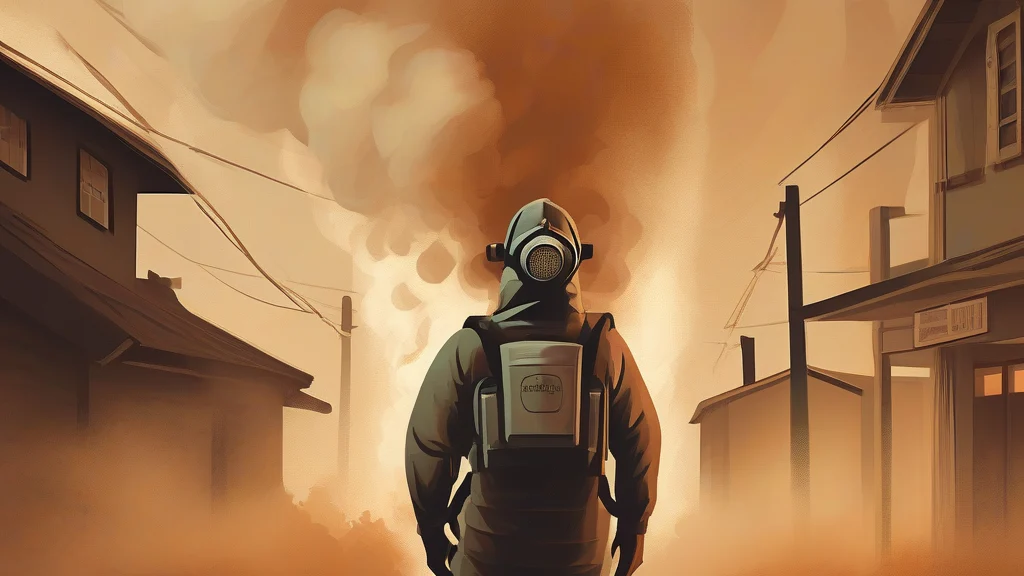
What does fumigate mean?
To fumigate is to treat an enclosed space with fumes, gas, or smoke in order to destroy pests, insects, rodents, fungi, bacteria, or other harmful organisms. The practice is common in agriculture, shipping, pest control, and public health: warehouses, grain silos, greenhouses, ships' holds, and infested homes are routinely fumigated with chemical agents designed to penetrate cracks and reach organisms hiding out of sight. Fumigation is usually carried out by trained professionals because the gases involved are potent and often hazardous, requiring sealed spaces and careful ventilation afterward. Derived from the Latin fumus, meaning 'smoke,' the verb entered English in the seventeenth century and shares its linguistic ancestry with words like perfume and fumitory. Though technical in register, fumigate remains widely understood and signals decisive, expert-level action against contamination or infestation.
verbTo disinfect or purify an enclosed space by exposing it to smoke, gas, or fumes, typically to destroy pests, pathogens, or other harmful organisms.
- To disinfect or clear a building, container, or area of pests or pathogens using gas, vapor, or smoke.
- More broadly (and less commonly), to purify or cleanse something thoroughly.
"The warehouse had to be fumigated to eliminate the termite colony behind its walls."
"Farmers fumigated the grain silos before storing the new harvest."
"Health officials ordered the entire hospital wing to be fumigated after the outbreak."
Fumigate literally means 'to apply smoke' — the same Latin root that gives us perfume, which once meant 'through smoke.'
Reviewed by Deb Chak, Editor. AI-assisted content curated by RJS Tech Solutions LLP.
Etymology of fumigate
Fumigate comes from the Latin fumigare, 'to apply smoke,' built on fumus, meaning 'smoke.' The verb passed into English in the early seventeenth century, when smoke-based purification was already a recognized method of treating disease-ridden spaces. It shares its Latin root with related English words such as perfume (originally referring to smoke rising through a space) and fumitory, a plant name.
Related word forms
How fumigate is actually used
Fumigate is a formal or technical verb, most often used in agricultural, pest-control, customs, and public-health contexts. It carries no strong emotional connotation but implies thoroughness and is associated with professional intervention rather than casual household cleaning. The word is used consistently across British and American English.
Easily confused with fumigate
While both end in '-gate'-sounding syllables, infiltrate means to enter secretly, whereas fumigate means to treat with fumes — they share no meaning.