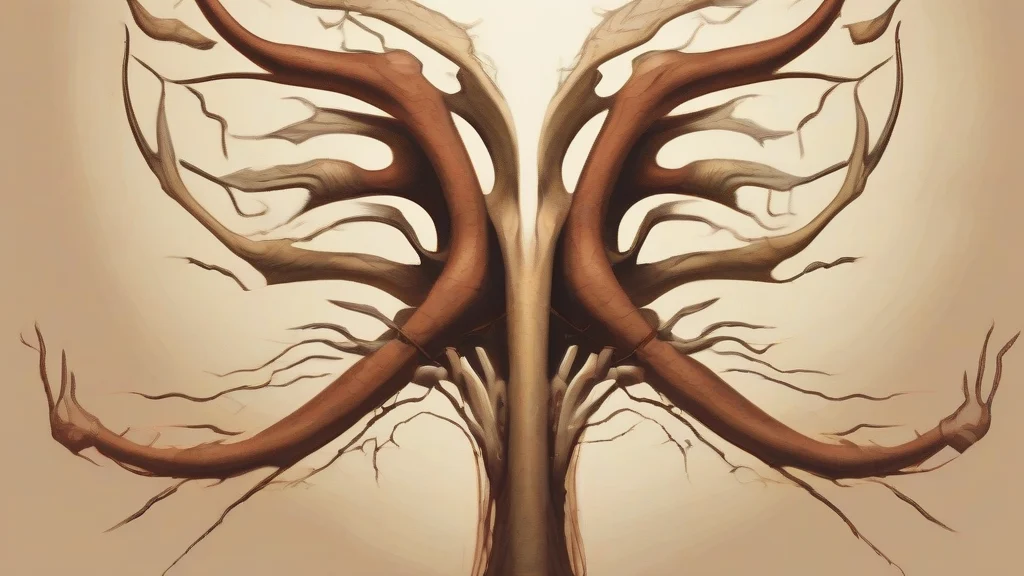
What does furculae mean?
Furculae is the plural of furcula, a term drawn directly from the Latin for 'little fork.' In its primary zoological sense, a furcula is the forked bone formed by the fusion of the two clavicles in birds—the structure known colloquially as the wishbone. Far from being an inert relic, the furcula functions as a spring-like brace that stores and releases energy during each wingbeat, making it central to the mechanics of bird flight. The term is extended by analogy to forked structures elsewhere in nature, including the jumping apparatus of springtail insects and the fused clavicles found in some theropod dinosaurs, a discovery that helped cement the evolutionary connection between dinosaurs and modern birds. Furculae appears chiefly in ornithology, comparative anatomy, and paleontology, so most everyday readers will know the structure under its folk name, the wishbone—a name bound up with centuries of good-luck traditions.
nounThe plural of furcula: the forked bone formed by the fusion of the two clavicles in birds, commonly known as the wishbone; the term is also applied to similar forked structures in other animals and in certain insects.
- The fused clavicles of birds, forming the forked wishbone that acts as a spring during flight.
- Any similarly forked anatomical structure, such as the forked tail-spring (furcula) of springtail insects or comparable elements in some theropod dinosaurs.
"The turkey's furculae were set aside to dry before the traditional wish-snapping ritual."
"In flying birds, the furculae store muscular energy during each wingbeat, acting like a spring between the shoulders."
"Paleontologists identified well-preserved furculae in several theropod fossils, strengthening the evolutionary link between dinosaurs and birds."
Furculae is itself the standard plural of furcula; because each bird possesses a single furcula, the plural refers to the structures of multiple birds or specimens.
"Researchers compared the furculae of raptors and songbirds to study differences in flight mechanics."
Every wish you've ever snapped over a wishbone was actually made on a pair of collarbones fused into one—Latin for 'little fork.'
Reviewed by Deb Chak, Editor. AI-assisted content curated by RJS Tech Solutions LLP.
Etymology of furculae
The word derives from the Latin furcula, meaning 'little fork,' itself a diminutive of furca, the Latin word for a fork or two-pronged implement—the same root behind the English verb forms 'furcate' and 'bifurcate,' which describe things splitting into two branches. Naturalists adopted the term in early modern scientific Latin to name the birds' fused clavicles precisely because of their distinctive Y shape. The same Latin lineage gives the structure its popular English nickname, the 'merrythought' or 'wishbone.'
Related word forms
How furculae is actually used
A technical term used mainly in ornithology, comparative anatomy, and paleontology; general readers are far more likely to encounter the word 'wishbone.' As the plural of 'furcula,' it is typically treated as a pluralia tantum form referring to multiple specimens rather than a naturally paired structure, since each bird has only one furcula.
Easily confused with furculae
A clavicle is a single collarbone, whereas a furcula is the single forked bone formed by the fusion of the two clavicles in birds.