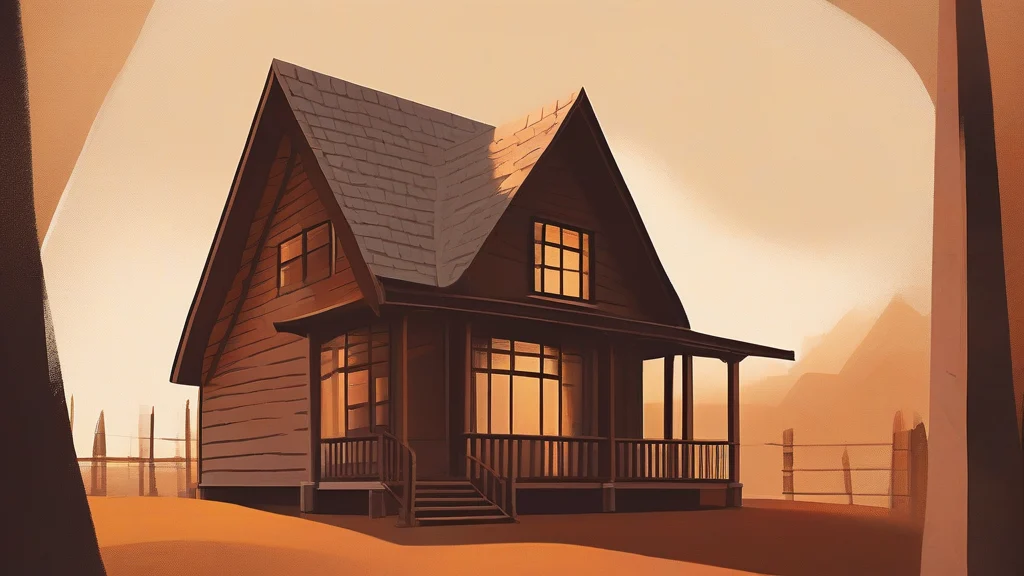
What does gabled mean?
'Gabled' is an adjective describing a building, roof, or façade that features one or more gables — the triangular upper section of a wall formed where two sloping sides of a roof meet at a ridge. It belongs almost entirely to the language of architecture, appearing in property listings, heritage descriptions, and travel writing about towns whose streets are lined with steep-roofed cottages, churches, and merchant houses. The word carries strongly picturesque connotations: gabled buildings evoke storybook charm, old European townscapes, and traditional craftsmanship, which is why writers reach for it when they want to signal character or antiquity. Variants such as 'Dutch-gabled', with its distinctive stepped or curved silhouette, add further descriptive precision. Simple but evocative, 'gabled' lets readers picture a building's profile instantly, making it a quietly useful word for anyone describing architecture.
adjectiveHaving or characterized by a gable — the triangular portion of a wall between the edges of a sloping roof. Used chiefly to describe houses and other buildings with such roofs.
- (of a building or roof) having one or more gables
"The village was a picturesque jumble of red-tiled, gabled cottages."
"They bought a charming gabled farmhouse on the edge of town."
"The street is lined with tall, narrow, Dutch-gabled merchants' houses."
Look up at a fairy-tale cottage and you're seeing 'gabled' at work — one of the few English adjectives borrowed straight from medieval French carpentry.
Reviewed by Deb Chak, Editor. AI-assisted content curated by RJS Tech Solutions LLP.
Etymology of gabled
The adjective 'gabled' derives from 'gable', the noun for the triangular end wall beneath a pitched roof. The noun came into Middle English from Old French, likely via Norman use of forms related to northern French 'gable', and has cognates across Germanic languages such as Norwegian and Swedish 'gabel/gavel'-type words for gables and gable-ends. The adjective formation — adding -ed to denote possession of the feature — follows the same pattern as words like 'walled' or 'turreted', and has been in standard architectural use since at least the early modern period.
How gabled is actually used
Used almost exclusively in architectural description and real-estate writing; it is nearly always paired with the building it modifies rather than standing alone. Often appears in compound modifiers such as 'Dutch-gabled' or 'steeply gabled'.
Easily confused with gabled
A gable is the triangular wall section itself, while gabled describes a building that has such sections.