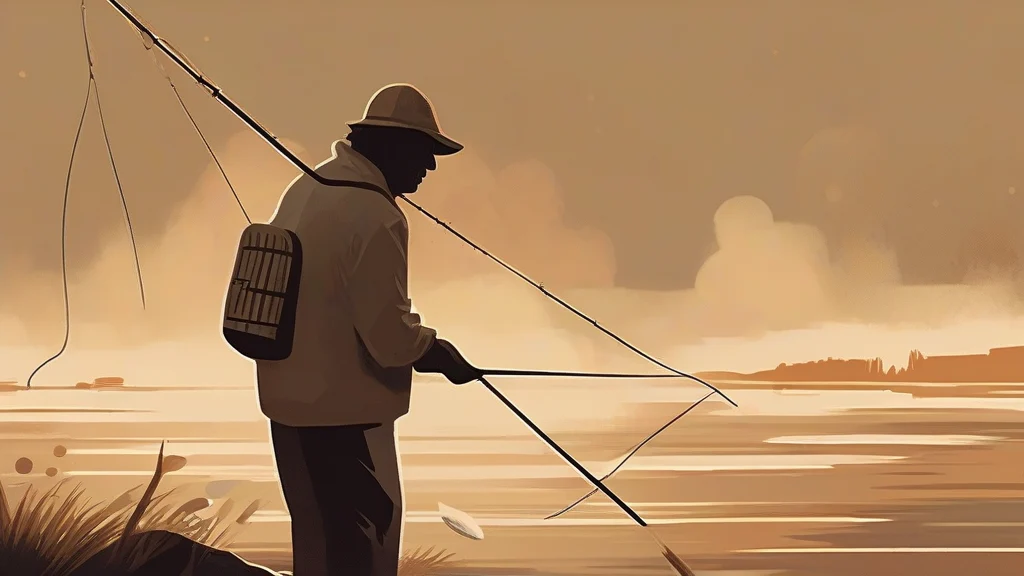
What does gaffing mean?
Gaffing is the act of landing a fish by impaling it on a gaff — a stout pole fitted with a large, sharp hook. Common in both recreational big-game angling and traditional commercial fishing, it is typically the final step after a fish has been fought to the boat, when an assistant hooks it under the shoulder or gill plate and swings it aboard. The word derives from 'gaff', a term that entered English in the seventeenth century from French, where it denoted a hooked staff. Because piercing a fish can damage both flesh and prospects for catch-and-release survival, gaffing has become somewhat controversial among conservation-minded anglers, many of whom prefer landing nets or cradles. The related noun 'gaffe', meaning an embarrassing social blunder, descends from the same hooked implement, making these two superficially similar words an unusual case of shared ancestry and wildly divergent meaning.
verbThe act of hooking a fish with a gaff — a large hooked pole — in order to land it. As a noun, it refers to this technique or the action itself.
- The action or technique of landing a fish by hooking it with a gaff.
- A gerund referring to the practice or activity of using a gaff in angling or commercial fishing.
"The deckhand leaned over the gunwale, gaffing the tuna and hauling it aboard in one smooth motion."
"After a long fight on light tackle, the mate finished the job by gaffing the marlin cleanly behind the shoulder."
"Gaffing was once standard practice on commercial longline boats, though many crews now use nets instead."
The humble gaff hook has landed prize fish for centuries — and its French cousin gave us the word 'gaffe' for putting your foot in your mouth.
Reviewed by Deb Chak, Editor. AI-assisted content curated by RJS Tech Solutions LLP.
Etymology of gaffing
'Gaffing' derives from 'gaff', a hooked pole adopted into English from French in the early modern period (attested from around the early seventeenth century); the French 'gafe' meant a hook or hooked staff, likely borrowed via maritime contact. The verbal sense — hooking and landing fish with such a tool — developed naturally alongside the implement's use at sea. The unrelated-seeming word 'gaffe', meaning a social blunder, comes from the same French source, having evolved through the idea of being 'caught' or tripped up.
Related word forms
How gaffing is actually used
Chiefly used in angling and commercial-fishing contexts; the term is technical rather than everyday. In sport fishing, 'gaffing' often carries connotations of the decisive final moment of landing a big fish, and debates over humane practices mean some fisheries discourage gaffing in favour of netting.
Easily confused with gaffing
A 'gaffe' is an embarrassing social blunder or faux pas, whereas 'gaffing' is the fishing practice of landing a fish on a hooked pole — the two words share an origin but have entirely different meanings.
A 'graf' (or graft) relates to horticulture or writing counts, while 'gaffing' concerns landing fish with a hooked pole.