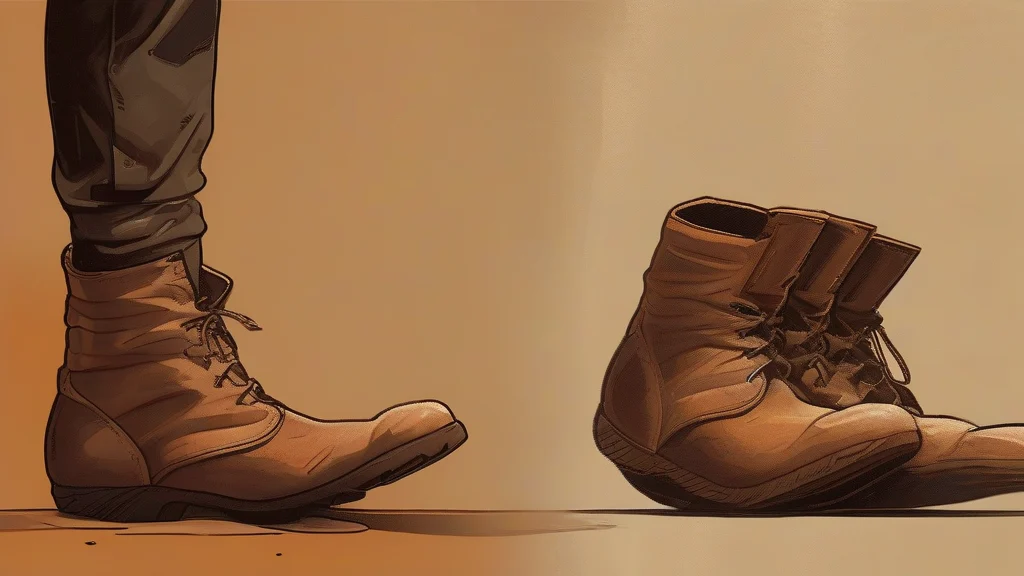
What does gaiter mean?
A gaiter is a protective covering worn over the lower leg and ankle, fastened around the calf and secured beneath or over the shoe to keep out mud, snow, rain, scree, and brush. Traditional gaiters were made of leather or heavy canvas and formed part of military and formal dress in the eighteenth and nineteenth centuries, but today the word most often refers to waterproof fabric gaiters used by hikers, trail runners, and snow travellers. A closely related modern sense is the neck gaiter, a tube of stretchy fabric pulled over the head to warm or cover the neck and lower face, which gained enormous visibility during the COVID-19 pandemic as an alternative face covering. Practical rather than glamorous, the word carries connotations of preparedness and outdoor competence, and it remains standard equipment terminology in hiking, skiing, and workwear contexts alike.
nounA gaiter is a protective covering for the ankle and lower leg, worn over the shoe and trouser, typically made of leather, canvas, or waterproof fabric. The term also applies to similar coverings for the neck or lower face.
- A covering for the ankle and lower leg, fastened over the shoe and trouser hem, worn to protect against mud, snow, water, stones, or brush.
- A tubular covering for the neck and lower face, often of stretch fabric ('neck gaiter'), worn for warmth or as a face covering.
"She pulled on her waterproof gaiters before setting out across the boggy moorland."
"The hikers strapped their gaiters tight to keep the wet snow out of their boots."
"On cold morning runs he wears a fleece neck gaiter instead of a scarf."
Standard plural; typically used because gaiters are worn as a pair, one per leg.
"He always packs spare gaiters when trekking in the wet season."
The humble gaiter went from Victorian bootwear to a pandemic staple almost overnight — when masks grew scarce in 2020, the neck gaiter became one of the most-seen garments in the world.
Reviewed by Deb Chak, Editor. AI-assisted content curated by RJS Tech Solutions LLP.
Etymology of gaiter
The origin of gaiter is somewhat obscure: it entered English in the seventeenth century, likely by way of French (compare French guêtre), but the ultimate source of the term has never been firmly established. Originally denoting a covering for the ankle worn over the shoe and stocking, the garment was absorbed into both civilian fashion and military uniform before its modern sporting uses emerged. Its recent extension to the neck covering known as a neck gaiter is a twentieth-century development that became widespread only in the 2010s and 2020s.
How gaiter is actually used
Gaiter is a straightforward everyday noun with no strong register constraints; it appears in both outdoor-sport vocabulary and historical or military writing (where leather gaiters were once standard dress). In contemporary usage the 'neck gaiter' sense has become especially widespread since around 2020.
Easily confused with gaiter
'Gator' is an informal shortening of alligator, whereas 'gaiter' is a garment worn on the leg or neck; the two merely sound alike.