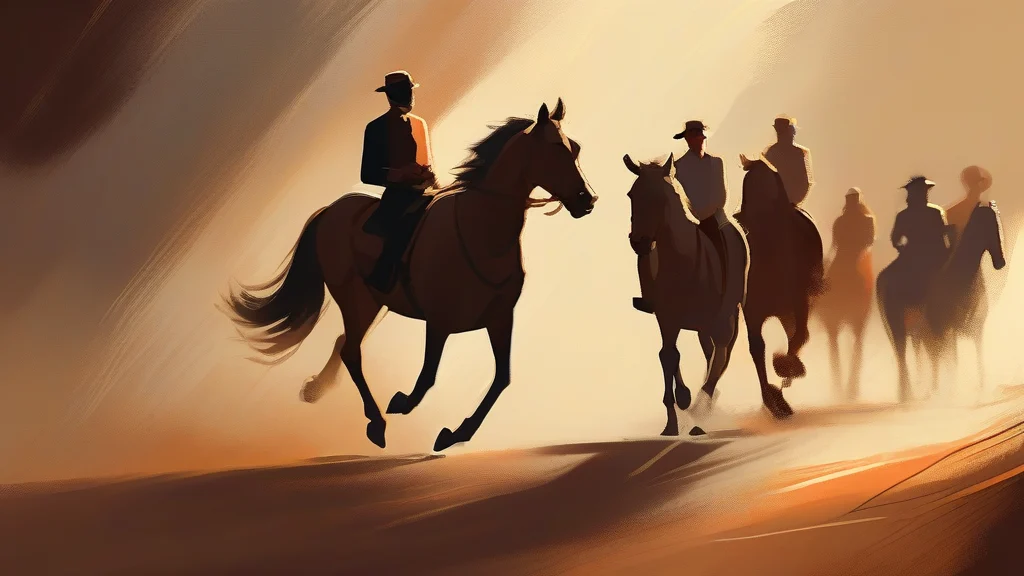
What does gaiting mean?
Gaiting is the present participle of the verb 'to gait', a term drawn from the specialized vocabulary of horsemanship. It describes the process of training a horse to perform particular gaits — the characteristic patterns of leg movement, such as walk, trot, canter, or the smoother four-beat ambling gaits prized in certain breeds. Trainers of gaited horses, including Tennessee Walking Horses, Saddlebreds, and Icelandics, devote considerable time to gaiting young animals so their natural stride develops into a comfortable, rhythmic movement for the rider. The word may also describe a horse simply moving at a given gait under saddle. Because it belongs almost entirely to equestrian usage, gaiting is unfamiliar to most general readers and is easily mistaken for the unrelated word 'gating', which concerns barriers or electronic signals. Its root, 'gait', derives from Old Norse 'gata', meaning path or way — a reminder that how a creature travels has always mattered to those who ride alongside it.
verb (present participle)The present participle of the verb 'gait': to teach or train a horse to perform particular gaits, or to move at a particular gait.
- The action of training a horse to develop or improve specific gaits.
- The action of a horse moving at, or being ridden at, a specified gait.
"The trainer spent months gaiting the young Tennessee Walking Horse so it would glide smoothly at the running walk."
"Breeders in Kentucky have long prized careful gaiting as the key to a naturally smooth saddle horse."
"The rider kept the colt gaiting evenly around the perimeter of the arena."
Gaiting is one of the rare words that lives almost entirely inside one world — the show ring, where smoothness of a horse's stride is an art form.
Reviewed by Deb Chak, Editor. AI-assisted content curated by RJS Tech Solutions LLP.
Etymology of gaiting
The word descends from 'gait', the noun naming an animal's manner of going. 'Gait' itself traces back to Old Norse 'gata' ('path, way'), which entered northern Middle English and came to denote a manner of walking or running; it is thus a cousin of modern English 'gate' in its older sense of 'way, street', still visible in place names like Galgate. From this noun arose the verb 'to gait', used by horse breeders and trainers, whose present participle gives us 'gaiting'. The adjective 'gaited', describing breeds with natural ambling gaits, belongs to the same small family.
Related word forms
How gaiting is actually used
'Gaiting' is a specialized term used almost exclusively in equestrian contexts, particularly among trainers of gaited breeds such as the Tennessee Walking Horse, Saddlebred, and Icelandic horse. It is uncommon in everyday speech and should not be confused with 'gating', which appears in engineering and security contexts. The related adjective 'gaited' describes breeds naturally inclined to smooth, four-beat gaits.
Easily confused with gaiting
'Gating' refers to controlling access with a gate or to electronic signal-gating, whereas 'gaiting' relates specifically to training or moving a horse in particular gaits.
'Gait' is the noun denoting the manner of walking or the pattern of leg movements itself, while 'gaiting' is the verbal form describing the act of training a horse in those gaits.