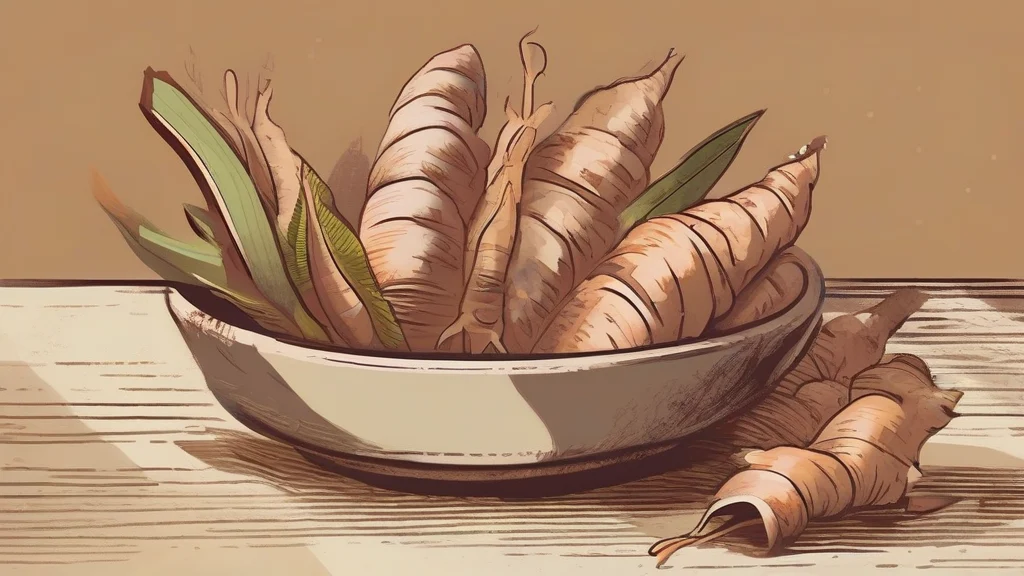
What does galangal mean?
Galangal is the name given to the pungent, aromatic rhizome of certain tropical plants in the ginger family, most importantly Alpinia galanga, known as greater galangal. Closely resembling ginger in appearance but sharper, more peppery, and faintly citrusy in flavour, it is an indispensable ingredient in Southeast Asian cuisines, lending its character to Thai tom yum soup, Indonesian rendang, and countless curry pastes. Because the rhizome is hard and fibrous, cooks typically bruise or slice it and simmer it in dishes, removing the pieces before serving, or pound it into pastes. Historically, galangal travelled westward along trade routes and was a prized spice in medieval European cookery and medicine before falling out of favour there. Today it is sold fresh, dried, powdered, or as a paste, and its distinctive bite makes it instantly recognisable to anyone who has tasted authentic Thai food.
nounThe aromatic rhizome of a tropical plant of the ginger family (chiefly Alpinia galanga), widely used as a pungent spice in Southeast Asian cooking.
- As a culinary spice: the pungent, aromatic rhizome of Alpinia galanga (greater galangal), used fresh, dried, or powdered in Southeast Asian cuisine.
- As a plant: the tropical perennial itself (Alpinia galanga or, for lesser galangal, Alpinia officinarum), cultivated for its rhizome.
"The tom yum owes its sharp, citrusy depth to slices of fresh galangal simmered in the broth."
"Bruise a few slices of galangal before adding them to the coconut-milk curry so they release their aroma."
"In medieval England, galangal was imported at great expense to perfume spiced wines and sweetmeats."
Usually treated as a singular mass noun referring to the rhizome; the plural is used mainly when counting individual rhizomes.
"She bought two plump galangals at the Asian grocer."
Medieval Europeans prized galangal so highly that it appears in the formulary of physicians of Myddvai and in Chaucer-era spiced wines — centuries before Thai curry made it famous.
Reviewed by Deb Chak, Editor. AI-assisted content curated by RJS Tech Solutions LLP.
Etymology of galangal
The word galangal entered English in the medieval period through Latin and Arabic channels, deriving from forms such as Arabic khūlanjān, which themselves traced back to a Chinese source describing the plant as a kind of 'mild ginger'. The closely related word galingale shares this lineage and long served as an alternative name in European texts. Its use reflects the medieval spice trade that carried Southeast Asian aromatics into European apothecaries and kitchens.
How galangal is actually used
In cooking, 'galangal' usually means the greater galangal (Alpinia galanga) common in Thai, Indonesian, and Malaysian food; 'lesser galangal' (Alpinia officinarum) has a sharper taste and is more associated with older European usage and traditional medicine. The rhizome is tough and fibrous, so it is typically sliced or pounded rather than grated finely, and it is often left in large pieces that diners push aside. The term is used almost exclusively in culinary and botanical contexts.
Easily confused with galangal
Galangal is a related but distinct rhizome with a sharper, more peppery, citrus-like flavour, whereas ginger is hotter and sweeter.
Galingale refers to sedges of the genus Cyperus whose tubers were used as a spice, while galangal is a rhizome of plants in the ginger family.