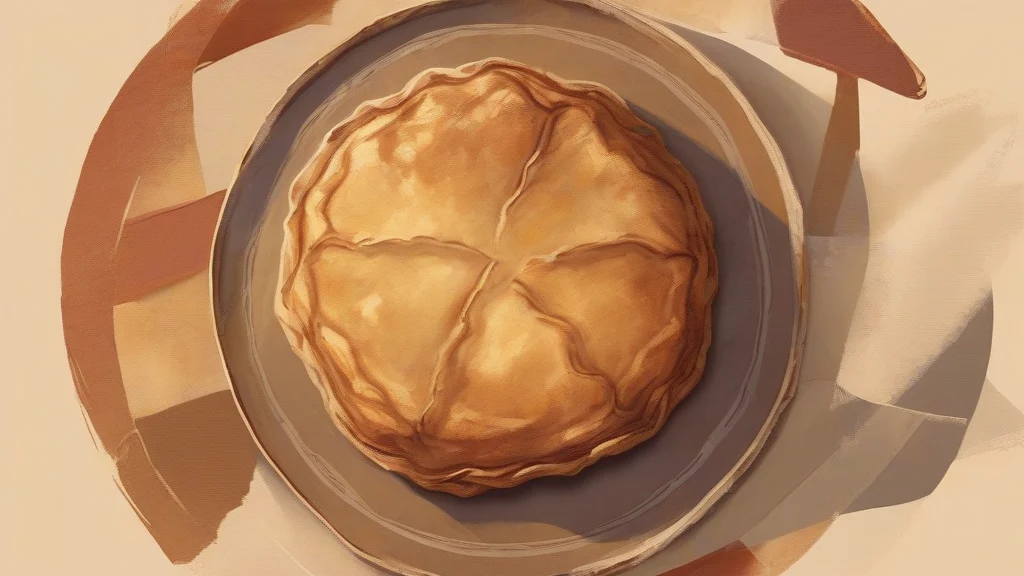
What does galette mean?
A galette is a flat, usually round pastry baked free-form, without a tin, its edges simply folded over the filling to create a rustic, irregular crust. Sweet versions filled with fruit are popular in home baking as an easy alternative to pie or tart, since they demand no special equipment or perfect crimping. The word, borrowed from French, also denotes the savoury buckwheat pancakes of Brittany, which are traditionally filled with ingredients such as ham, cheese, and eggs, and the galette des rois, the flaky almond-filled King Cake enjoyed in France around Epiphany. Because it evokes French country cooking and unpretentious craftsmanship, 'galette' carries warm, rustic connotations in food writing and menus. It is a useful word for anyone interested in cooking or European cuisine, capturing both a specific technique and a whole aesthetic of simple, honest baking.
nounA galette is a free-form, flat pastry or cake, typically round, that is baked without a tin; in French cuisine it also refers to savoury buckwheat pancakes of Brittany.
- A free-form, round flat pastry with the edges folded over the filling, sweet or savoury, baked directly on a sheet.
- A savoury buckwheat pancake characteristic of Breton cuisine.
- (French context) A galette des rois, the flaky King Cake eaten around Epiphany.
"She folded the rustic edges of the apple galette over the fruit and slid it into the oven."
"For dessert, she made a peach galette, folding the rough edges of the dough over slices of fruit and scattering sugar on top."
"At the crêperie he ordered a buckwheat galette filled with ham, cheese, and a fried egg."
The standard English plural simply adds -s; the word remains a French loanword but is fully naturalized in culinary contexts.
"The café offered individual apricot galettes alongside its tarts."
In France, eating a slice of the galette des rois on Epiphany comes with a twist: whoever finds the hidden charm inside becomes king or queen for the day.
Reviewed by Deb Chak, Editor. AI-assisted content curated by RJS Tech Solutions LLP.
Etymology of galette
The word galette was borrowed into English from French, where it refers to various flat, round cakes and pancakes. Its precise ultimate origin within Old French is debated among lexicographers, so only its French source can be stated with confidence. English adopted the term primarily through exposure to French culinary tradition, especially Breton buckwheat galettes and the Epiphany galette des rois.
How galette is actually used
The word carries a distinctly French, rustic-culinary connotation in English usage and appears almost exclusively in food writing and restaurant menus rather than everyday conversation. In Anglophone baking culture, 'galette' often signals an intentionally casual, free-form alternative to a formal tart or pie.
Easily confused with galette
A tart is baked in a tart pan or ring with straight sides, while a galette is free-form and baked flat on a baking sheet.
A gaufrette is a thin crisp wafers made in a waffle iron, whereas a galette is a soft flat pastry or pancake.