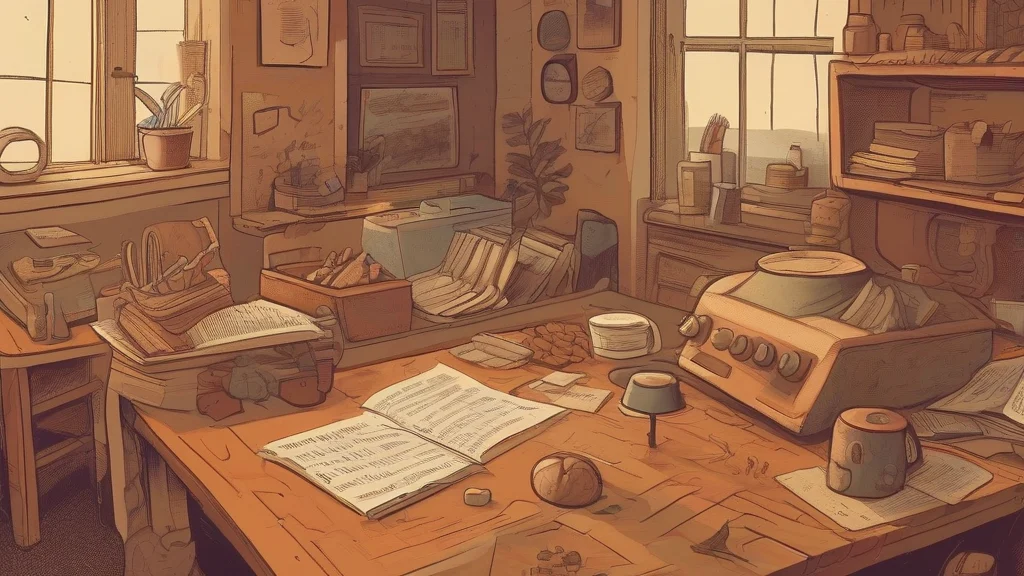
What does gallimaufry mean?
A gallimaufry is a jumbled, heterogeneous mixture — a gathering of dissimilar things thrown together without order. The word is used almost exclusively in the pattern 'a gallimaufry of …', describing anything from an eclectic art exhibition to a disorganised essay or an assortment of inherited furniture. Its connotations are generally benign, even charming: a gallimaufry suggests variety and improvisation more than chaos, though it can serve as a gentle criticism when coherence was expected and missing. Derived in the sixteenth century from French 'galimafrée', which appears to have referred originally to a dish of hashed leftovers, the word retains a whiff of the kitchen in figurative use — a gallimaufry is what you get when everything left over goes into the pot. It remains a rare but useful word for writers seeking a vivid, slightly antique alternative to 'hodgepodge' or 'miscellany'.
nounA confused jumble or hodgepodge of disparate things; a disorderly mixture of unrelated elements.
- A heterogeneous collection or jumble of unrelated things.
- (Historical) A dish made of odds and ends of food boiled together; a hash or ragout.
"The festival was a delightful gallimaufry of music, food stalls, and street theatre."
"Her bookshelf was a gallimaufry of cookbooks, thrillers, and forgotten textbooks."
"The report was a gallimaufry of statistics, anecdotes, and half-finished arguments."
The plural is rare, since the word typically appears within the singular construction 'a gallimaufry of …'. Use the plural only when speaking of multiple such mixtures.
"The two anthologies were gallimaufries of wildly uneven quality."
Before it meant any old jumble, 'gallimaufry' was literally on the menu — it began as a French word for a stew made of whatever scraps the kitchen had left.
Reviewed by Deb Chak, Editor. AI-assisted content curated by RJS Tech Solutions LLP.
Etymology of gallimaufry
Gallimaufry entered English in the sixteenth century, borrowed from French 'galimafrée', a term that seems to have denoted a dish of scraps or leftovers cooked together, akin to a hash or ragout. The internal make-up of the French word is uncertain, and its exact components remain disputed, so its deeper derivation cannot be stated with confidence. From its culinary origins the English word broadened into a general term for any disorderly medley, first attested in printed use by the late sixteenth century.
How gallimaufry is actually used
Almost always used today in the phrase 'a gallimaufry of …', giving the word a slightly formal, literary register. It carries a mildly whimsical or affectionate connotation — the mixture is colourful rather than merely chaotic — though it can be used critically when describing disorganised writing or thinking. Rare outside descriptive prose; most everyday speakers would reach for 'hodgepodge' or 'miscellany' instead.
Easily confused with gallimaufry
Though both begin with 'gall', gallivant means to roam about aimlessly or for pleasure, whereas gallimaufry is a noun denoting a jumbled mixture.
Hodgepodge is a near-equivalent term for a jumbled mixture, but it is a plainer word of separate origin, while gallimaufry carries a more literary, whimsical flavour.