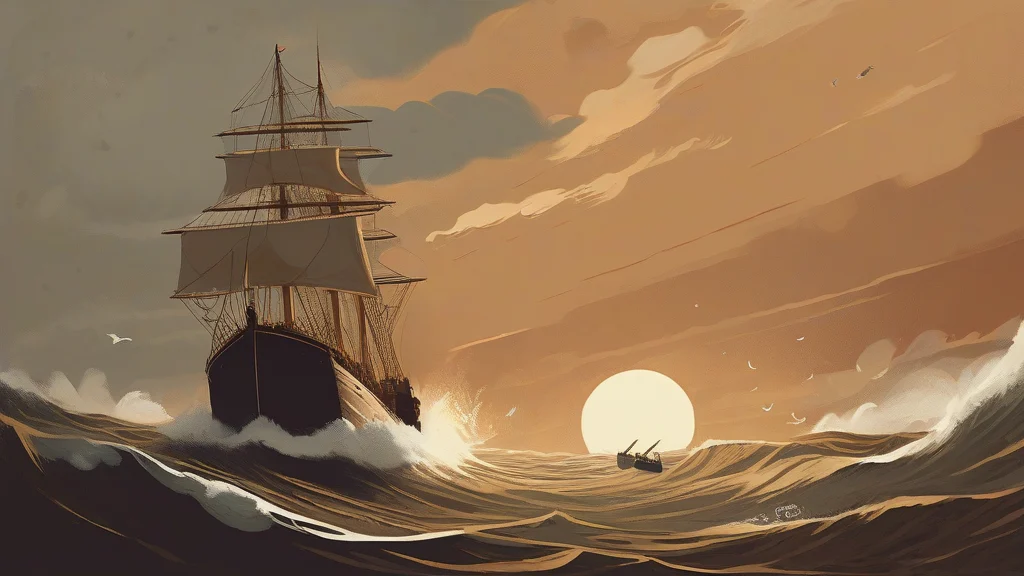
What does gam mean?
A 'gam' denotes a social aggregation of whales at sea — not a tightly organized herd but a loose, temporary gathering, most famously associated with sperm whales, which are notably sociable. The term emerged in nineteenth-century American whaling circles, where it carried a second meaning: when two whaling ships crossed paths far from land, they would hold a 'gam,' lying together for hours or days while crews exchanged mail, news, and yarns. Herman Melville devotes a chapter of Moby-Dick to this custom, making the word a small piece of maritime literary history. Today 'gam' survives mainly among whale watchers and marine biologists describing whale gatherings, while its older shipboard meaning lives on in historical accounts. A related slang sense, using 'gam' for a woman's legs, circulated in twentieth-century America but has largely faded. The word offers an evocative glimpse into the vocabulary of the age of commercial whaling.
nounA 'gam' is a social gathering or school of whales at sea; in 19th-century whaling it also referred to the convivial visit exchanged between two whaling ships that met at sea.
- A group or school of whales swimming together.
- (historical, nautical) A social visit or rendezvous between two whaling ships that met at sea.
- (dated slang, chiefly 20th-century US) A woman's legs, especially regarded as attractive.
"The lookout sighted a gam of sperm whales off the starboard bow."
"The research vessel spent the morning observing a gam of humpbacks feeding near the surface."
"In the days of sail, two whalers would lie to and enjoy a gam, swapping letters and news from home."
Standard plural; counts multiple gatherings of whales.
"Several gams were sighted along the continental shelf that season."
Herman Melville wrote about gams in Moby-Dick — a 'gam' was the 19th-century whaler's version of catching up on gossip at sea.
Reviewed by Deb Chak, Editor. AI-assisted content curated by RJS Tech Solutions LLP.
Etymology of gam
'Gam' entered English as American whaling slang in the first half of the nineteenth century, though its precise origins remain obscure; some sources suggest influence from Dutch or other maritime languages used by whalemen, but no definitive source is established. The word's dual meaning — both a whale aggregation and a shipboard social visit — reflects the whalers' habit of naming their world's distinctive phenomena. It gained lasting recognition through Melville's Moby-Dick (1851), which describes the custom of the gam in detail.
Related word forms
How gam is actually used
The word originated as American whaling terminology in the early-to-mid 19th century and survives today mainly among whale watchers and naturalists, who use it to describe a loose social aggregation of whales, especially sperm whales. The historical sense describing visits between whaling ships is now largely of literary interest, appearing in accounts of whaling voyages and in Melville's Moby-Dick. The slang use of 'gam' for a woman's legs, popular in mid-20th-century America, is dated and may be considered sexist today.
Easily confused with gam
'Gem' is a precious stone, while 'gam' refers to a gathering of whales or a friendly rendezvous between ships.