What does gambade mean?
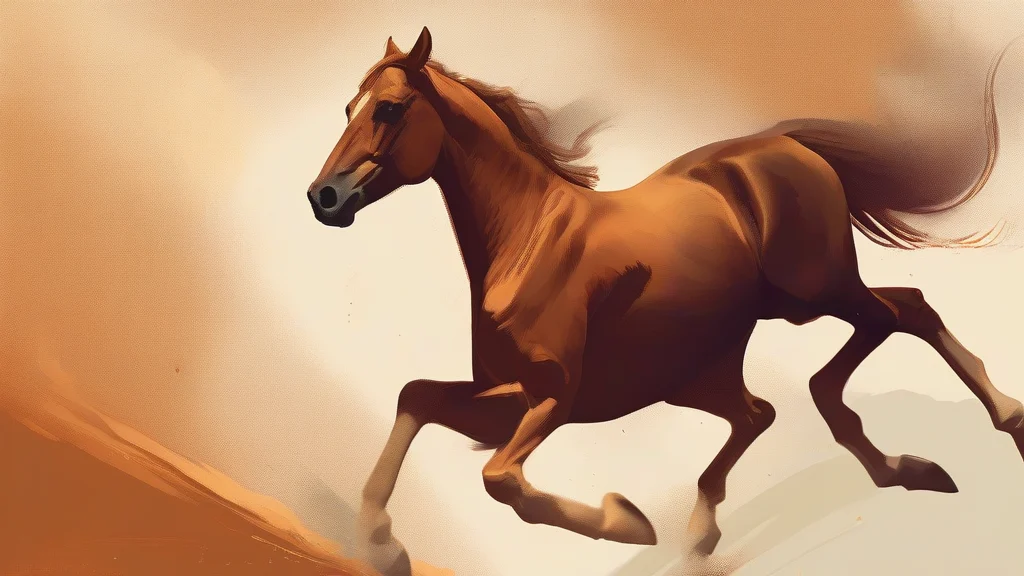
A gambade is a leap or spring made by a horse, in which the animal jumps upward with all four feet leaving the ground at once. Historically, the term belonged to the vocabulary of horsemanship, describing one of the spirited bounds that trained horses perform in manege work and classical dressage, and by extension it came to suggest any lively, playful capering movement. As a verb, now quite rare, 'to gambade' means to leap or prance in this fashion. The word entered English from French 'gambade' in the late sixteenth or early seventeenth century, ultimately deriving from Italian 'gambata', built on 'gamba', meaning leg — a word inherited from Late Latin. Its closest English relative is 'gambol', which shares the same root but has drifted toward meaning general frolicking. Today 'gambade' survives mainly in equestrian, historical, and literary writing, lending a precise, slightly antique flourish to descriptions of equine motion.
A leap or spring of a horse, in which all four feet leave the ground at once.
"The Andalusian performed a graceful gambade before the assembled court."
Chiefly found in historical treatises on horsemanship and in literary description.
To make a gambade; to leap or prance like a spirited horse.
"The colts gambaded about the paddock in the evening light."
Rare in modern usage; generally replaced by 'prance' or 'caper'.
Standard pluralization for the noun sense referring to multiple leaps.
"The horse's gambades drew applause from every corner of the arena."
Before horses could dance at dressage competitions, they were already showing off their 'gambades' — leaps borrowed from an Italian word for a leg.
Reviewed by Deb Chak, Editor. AI-assisted content curated by RJS Tech Solutions LLP.
Etymology of gambade
'Gambade' entered English from French in the late sixteenth or early seventeenth century, borrowed from French 'gambade', meaning a leap or spring. The French word derives from Italian 'gambata', literally 'a movement of the leg', formed on 'gamba', meaning leg. 'Gamba' itself comes from Late Latin 'gamba', originally denoting the hoof or hock of a horse. The same root gave English 'gambol', to frolic or skip, and survives in 'viola da gamba', the stringed instrument held between the legs.
Related word forms
How gambade is actually used
'Gambade' is now largely confined to historical, equestrian, or literary contexts. It appears chiefly in discussions of horsemanship and classical dressage, where it names one of the airs or movements of trained riding horses. The word carries a slightly archaic, ornamental flavor and would strike most modern readers as unfamiliar; 'prance', 'caper', or 'leap' are more natural choices in everyday writing.
Easily confused with gambade
'Gambol' means to frolic or skip playfully and comes from the same root, while 'gambade' specifically denotes a horse's leap or spring.
'Gamble' means to play games of chance for money and shares only an accidental similarity in sound with 'gambade'.