What does gamboge mean?
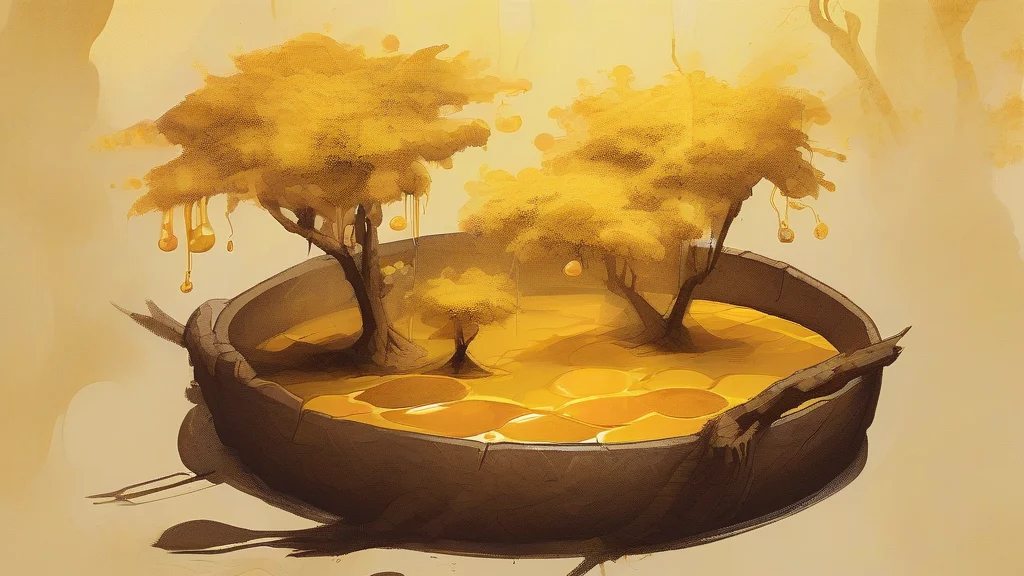
Gamboge is a deep, luminous golden-yellow pigment made from the gum resin of trees of the genus Garcinia, native to Southeast Asia. The name derives from gambogium, the medieval Latin rendering of Cambodia, reflecting the region from which the resin was historically exported to Europe. Prized by watercolorists from the seventeenth century onward for its transparency and intensity, gamboge was used both in fine art and in more utilitarian applications such as tinting varnishes and inks; the resin was also once employed in medicine as a drastic purgative. Today the word survives primarily among artists, conservators, and historians of pigment, though it also names the distinctive yellow hue itself. Gamboge offers writers and speakers a precise, evocative alternative to generic terms like 'yellow' when describing rich, warm, resinous color.
A gum resin from Garcinia trees of Southeast Asia, used as a deep golden-yellow pigment and formerly in medicine.
"The restorer identified gamboge in the eighteenth-century watercolor's highlights."
Also used attributively to denote the color, as in 'a gamboge dress'.
The deep yellow color characteristic of this pigment.
"The sunset turned the harbor water a vivid gamboge."
Rarely pluralized; the plural appears mainly when referring to distinct samples or varieties of the resin.
"The collection included gamboges from several different Garcinia species."
The word 'gamboge' is literally the medieval Latin name for Cambodia — European traders named the pigment after the country it shipped from.
Reviewed by Deb Chak, Editor. AI-assisted content curated by RJS Tech Solutions LLP.
Etymology of gamboge
Gamboge entered English in the early 17th century, borrowed from French camboge/gamboge, which came from gambogium, the medieval Latin name for Cambodia — the country through which the resin was traded. The word thus preserves an unusual direct link between an English color term and a Southeast Asian place-name. Related forms include the adjective gambogic, used in chemistry for acids derived from the resin.
Related word forms
How gamboge is actually used
Gamboge is a specialized term encountered mainly in art history, painting, and discussions of historical pigments; it is formal rather than everyday vocabulary. The plural is uncommon but appears when referring to multiple varieties or samples of the resin.
Easily confused with gamboge
Gamboge is a yellow pigment derived from a tree resin, while gambol is a verb meaning to run or skip about playfully.