
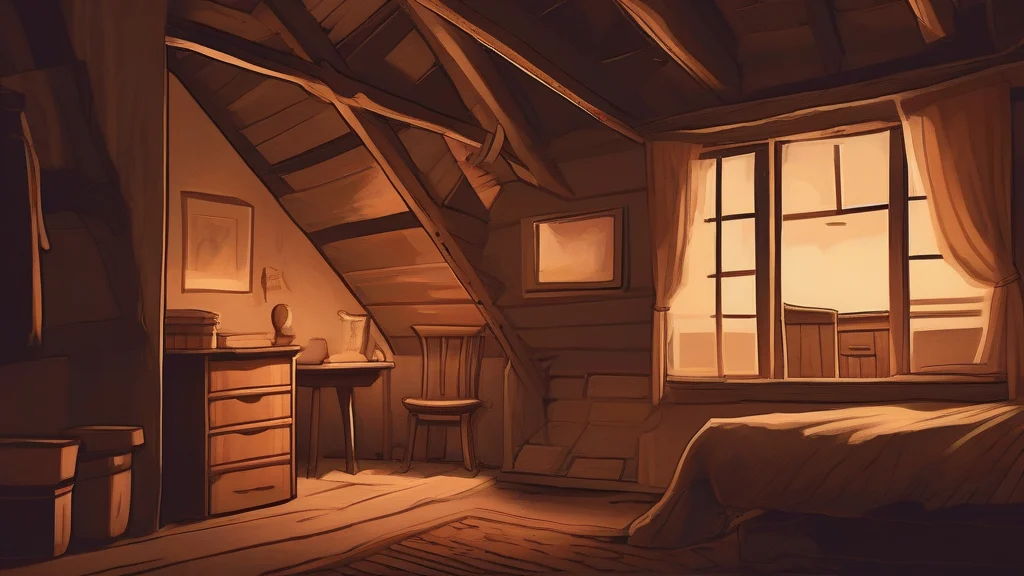
What does garret mean?
Garret means an attic or loft: a room, or group of rooms, occupying the upper part of a building, especially directly beneath the roof. In older contexts, it could also denote a high lookout room in a tower. The word is still used in British and American English, but it has a more literary or old-fashioned tone than the ordinary term attic. Because garret often describes a relatively small upper space, it may suggest a cramped room under the eaves, although the word is not limited to poor or servant quarters. It appears naturally in phrases involving rooms in old buildings, loft conversions, and characters working or living in attics. Etymologically, garret entered English from French, where its older relatives referred to a turret or watchtower. The word later developed the familiar sense of an attic, preserving the idea of an elevated or topmost part of a structure.
nounA room or set of rooms at the top of a house, especially one immediately beneath the roof; an attic or loft. The word formerly also referred to an upper room or lookout in a tower.
- A room or set of rooms in the upper part of a house, especially directly beneath the roof.
- Historically, an upper room or lookout at the top of a tower.
"A narrow garret beneath the eaves made an unexpectedly peaceful writing room."
"A narrow garret beneath the eaves made an unexpectedly peaceful writing room."
"The miller stored his tools in a small garret at the top of the building."
The standard plural is formed by adding -s to the noun.
"The building contains two narrow garrets overlooking the street."
Before it meant an attic, garret was associated with watchtowers and the lofty lookout positions of fortified buildings.
Reviewed by Deb Chak, Editor. AI-assisted content curated by RJS Tech Solutions LLP.
Where does garret come from?
The English word entered English in the sixteenth century from Middle French garrette, a term associated with a turret or watchtower. The French word is related to Old French garite and Latin garita, which likewise referred to a fortified or elevated lookout position. As English usage developed, the meaning shifted toward an upper room beneath a roof, while modern French garet retains the sense of an attic or loft.
How garret is actually used
The word is somewhat literary or old-fashioned in contemporary use, particularly in American English. It is close in meaning to attic but can suggest a small, confined, or modest upper room. Attic is the more usual neutral term in both varieties.
Easily confused with garret
A garret is an upper room or attic, whereas a garrote is an instrument for strangling or, as a verb, means to strangle.