
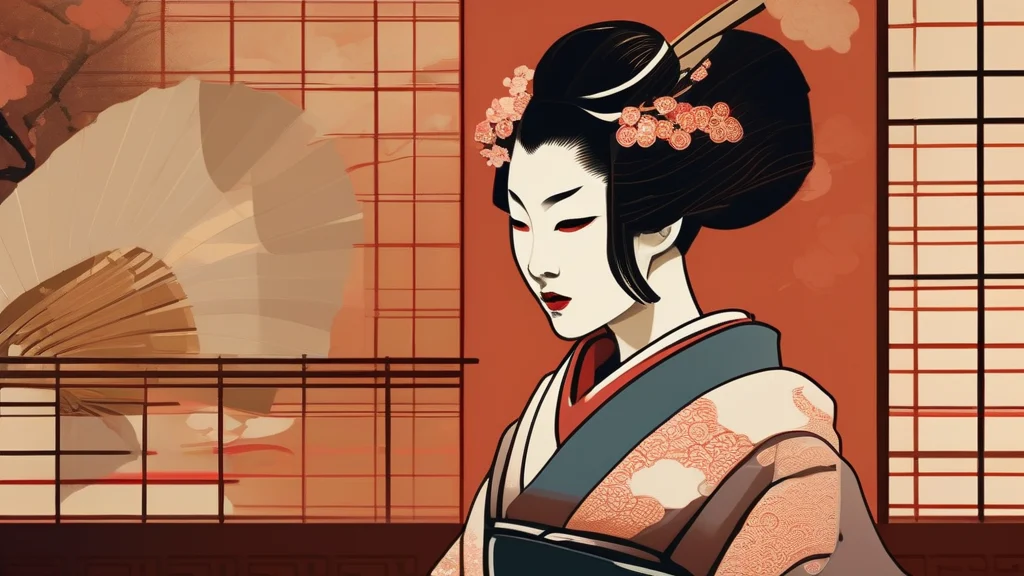
What does geisha mean?
Geisha refers to a woman associated with traditional Japanese professional entertainment, especially the performance of music, dance, poetry, and other classical arts. A geisha may work in an entertainment or dining district, entertaining clients through conversation and artistic performance while wearing distinctive traditional dress. The English word comes from Japanese and is sometimes confused with courtesan or treated as a synonym for prostitute, but these terms do not describe the same traditional occupation. Geisha have a formal training culture, and an apprentice geisha is commonly called a maiko, particularly in Kyoto. In contemporary usage, geisha can also refer more broadly to a woman associated with Japanese traditional culture, though this extension can carry implications of theatricality, elegance, or exoticism that are not present in the narrower historical sense.
nounA Japanese woman traditionally trained in classical arts such as music, dance, poetry, and tea ceremony, who performs for clients and may work in a geisha house. The term also broadly refers to a woman associated with traditional Japanese entertainment and dress.
- A woman in Japan, or sometimes outside Japan, associated with professional entertainment in traditional Japanese arts and with the dress and customs historically associated with that profession.
"She spent the evening listening to a geisha perform classical music in Kyoto."
"The film portrayed a geisha navigating the social conventions of Kyoto's entertainment districts."
"Tourists watched a geisha perform classical dance while dining in a traditional restaurant."
The noun is commonly unchanged in the plural; plural geishas also occurs but is less usual.
"Several geisha performed during the evening."
A geisha was traditionally an artist of refined Japanese performance, not simply a prostitute—a distinction frequently lost in translation.
Reviewed by Deb Chak, Editor. AI-assisted content curated by RJS Tech Solutions LLP.
Where does geisha come from?
The English word comes from Japanese 芸者 (geisha), a compound of 芸 (gei), meaning art, skill, or accomplishment, and 者 (sha), meaning person; it literally denotes a person skilled in the arts. The borrowing entered English in the late nineteenth century, amid growing Western interest in Japanese art and culture. Japanese terms such as geiko, geijutsu, and geinō share the element gei, although only some are direct terms for a female geisha.
How geisha is actually used
In modern English, geisha can denote either a traditional Japanese professional entertainer or, more broadly, a woman associated with that tradition. It is sometimes used in popular culture for a highly stylized or sexually suggestive female figure, so context matters. The term is not simply equivalent to prostitute, although commercial sex and geisha traditions have sometimes overlapped historically.
Easily confused with geisha
A geisha is a professional performer trained in traditional Japanese arts, whereas a courtesan is primarily a hired companion and, historically, a sexual companion.
A maiko is an apprentice geisha in Kyoto who is still training in traditional arts, while a geisha is generally a more established performer.