
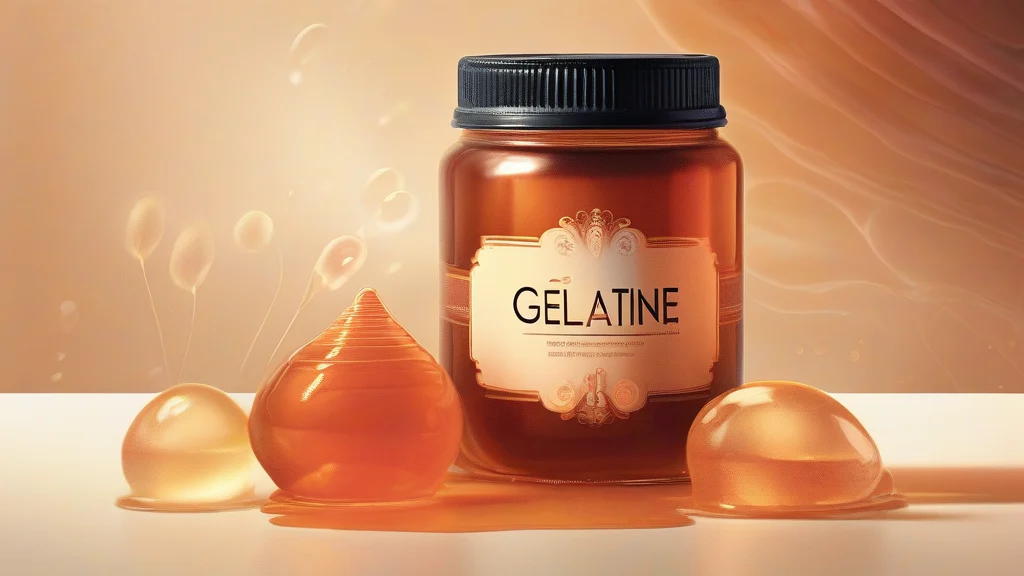
What does gelatine mean?
Gelatine is a firm, transparent protein substance obtained from animal collagen, most often from bones and hides. Its defining property is reversible: it dissolves in hot liquid and sets into a jelly-like gel as it cools. In the kitchen, it acts as a setting agent for fruit desserts, confectionery, aspics, and some marshmallows; in other contexts, it forms clear capsules or photographic films. Because it is made from animal collagen, gelatine is not suitable for strict vegetarian or vegan diets, although plant-based setting agents exist and should not be called gelatine. The word has a technical as well as a culinary history and reflects a close relationship between cooking and early photographic processes. Gelatine is therefore useful to know not merely as another name for jelly, but as a functional material: the same substance that gives a dessert its shape can help make a photographic image permanent.
nounA transparent, colourless to pale-yellow protein substance made by extracting collagen from animal connective tissue, which dissolves in hot water and sets into a firm gel on cooling. It is used as a food setting agent and in capsules, pharmaceuticals, and photographic emulsions.
- A transparent protein substance obtained from animal collagen that dissolves in hot liquid and sets into a firm gel when cooled.
- A jelly-like food preparation made with this substance, often containing fruit, cream, or other ingredients.
- A clear film or coating used to bind photographic emulsion or other sensitive materials.
"The recipe uses leaf gelatine to set the fruit dessert."
"The pastry chef folded whipped cream into a delicate gelatine dessert."
"The photographer exposed a plate coated with gelatine to form the image in the emulsion."
The plural is uncommon and usually refers to distinct products or materials, particularly photographic sheets or films.
"Different gelatines are used for different printing processes."
Hot liquid, cold jelly: gelatine turns collagen into a clear gel that can hold fruit, cream, or a photographic image in place.
Reviewed by Deb Chak, Editor. AI-assisted content curated by RJS Tech Solutions LLP.
Where does gelatine come from?
The English noun was borrowed in the early nineteenth century from French gélatine, a derivative of Latin gelātinus, meaning “gelatinous” or “jelly-like.” Latin gelātinus in turn comes from gelāre, “to freeze” or “make solid,” the same root behind gelate, gelation, and congeal. The name reflects the substance's characteristic ability to form a firm, jelly-like solid when cooled.
Related word forms
How gelatine is actually used
The noun is usually uncountable when referring to the substance. Plural usage is limited and chiefly occurs when distinguishing discrete products or materials, such as photographic films; in food contexts, “gelatine” normally names the ingredient rather than the individual dessert.
Easily confused with gelatine
Gelatine is the usual British spelling, while gelatin is the usual American spelling; both denote the same substance.