
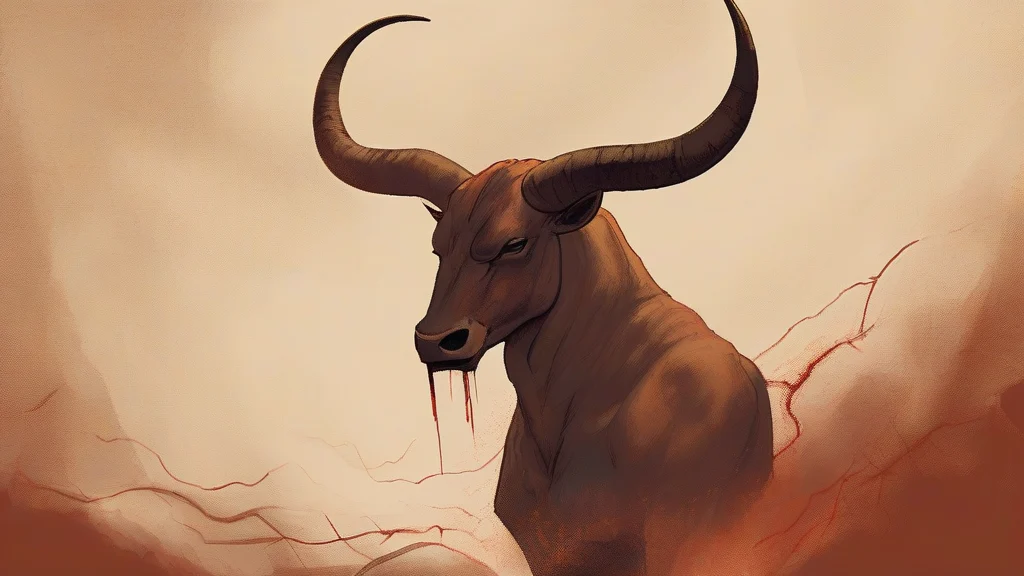
What does gored mean?
Gored is an uncommon English word with two related uses. As an adjective, it means bloodied or covered in blood, and it often describes a person, animal, garment, or surface left bloody by injury. In narrative writing, the word can be deliberately stark: a fallen hunter may be gored, while clothing may be described as stained with blood. As a verb form, gored is the past tense and past participle of gore, meaning to pierce or wound with a horn, tusk, or other sharp point; a bull may gored a fence, or an animal may have been gored by another. The adjective and verb forms share the same violent associations, although gored as an adjective draws attention especially to the resulting blood. The word is chiefly literary, dramatic, or archaic in tone rather than everyday neutral description. It is useful for concentrated, graphic prose, where the precise sense matters: gored by a horn describes the act and wound, while gored with blood describes the bloodied result. Pronunciation differs chiefly between rhotic American English and non-rhotic British English.
Covered or stained with blood; bloodied.
"The wounded deer lay gored in the tall grass."
Chiefly literary or archaic; its force is vivid and blood-related.
The past tense and past participle of gore: pierced or wounded, especially by a horn, tusk, or other sharp point.
"Once, the bull gored the fence before it was brought down."
Used in narrative prose for violent actions, particularly those involving animals with horns or tusks.
Gored compresses an entire scene of blood, violence, and injury into a single vivid word.
Reviewed by Deb Chak, Editor. AI-assisted content curated by RJS Tech Solutions LLP.
Etymology of gored
The adjective gored was formed from gore, the Old English word for blood, with the suffix -ed. The verb gore came through Middle English from the same Old English stem and means to pierce or wound, especially with a horn or tusk. Modern gore and gory also continue this blood-related root.
How gored is actually used
The adjective is uncommon and chiefly literary or archaic, with a stark and graphic association. The verb form is standard in narrative prose but often describes violent events. American pronunciation is normally rhotic, while British pronunciation is normally non-rhotic.
Easily confused with gored
Gore is the base verb and noun, while gored is its past form and an adjective meaning bloodied.