
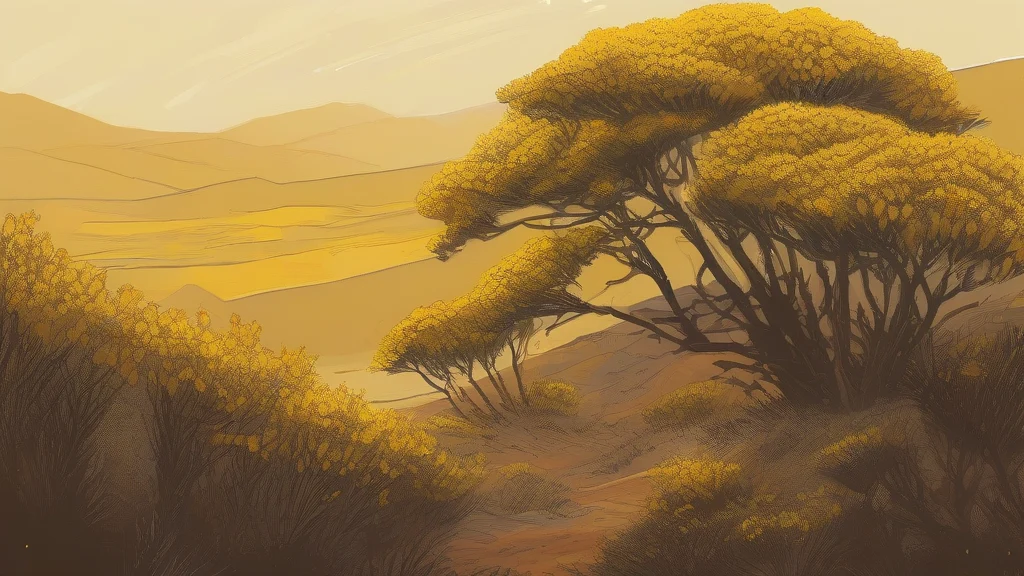
What does gorse mean?
Gorse is the common regional name for Ulex europaeus, a tough, prickly shrub with small evergreen leaves and conspicuous yellow flowers. It is especially associated with British and Irish hedges, moorland, heath, and rough ground, where it can form dense, difficult-to-cross scrub. The word may refer to a single bush, a mass of such vegetation, or land covered by the plant. Gorse is valued for its striking spring colour but is often unwelcome in gardens and farmland because of its sharp spines and vigorous growth. It is also known as furze and, in some regions, whin. Although the plant is sometimes treated as a weed or invasive species, it provides distinctive habitat and character to landscapes that would otherwise be bare. In literature and local speech, gorse often evokes rugged countryside, shelter, and vivid yellow colour.
The prickly, yellow-flowered shrub Ulex europaeus; also, dense scrub or ground covered by this plant.
"The lane ran alongside a bank of gorse covered in bright yellow blossom."
Chiefly regional in British and Irish English. The ordinary mass use often refers collectively to the plant or vegetation, while gorses can refer to individual shrubs.
Archaic: to cover ground with gorse or furnish an area with gorse bushes.
"The villagers gorsed the boundary to keep the cattle from straying."
This use is archaic and uncommon in contemporary English.
Used for individual shrubs or countable groups of the plants; gorse is also commonly used as a mass noun for the plant, vegetation, or material.
"Several gorses grew along the abandoned railway line."
Gorse turns hedges into brilliant yellow spring displays, but its sharp spines make it the bane of anyone trying to walk through them.
Reviewed by Deb Chak, Editor. AI-assisted content curated by RJS Tech Solutions LLP.
Where does gorse come from?
The word descends from Old English gorse, a Germanic term for the prickly shrub. It continued in Middle English and modern regional English, where it became especially associated with hedges, moorland, and uncultivated ground in Britain and Ireland. The plant is also widely called furze, a name with its own distinct historical development.
Related word forms
How gorse is actually used
Gorse is chiefly a regional term in British and Irish English and is often used for both the individual shrub and dense vegetation composed of it. The verb meaning 'to cover with gorse' is archaic and rarely encountered in modern writing.