
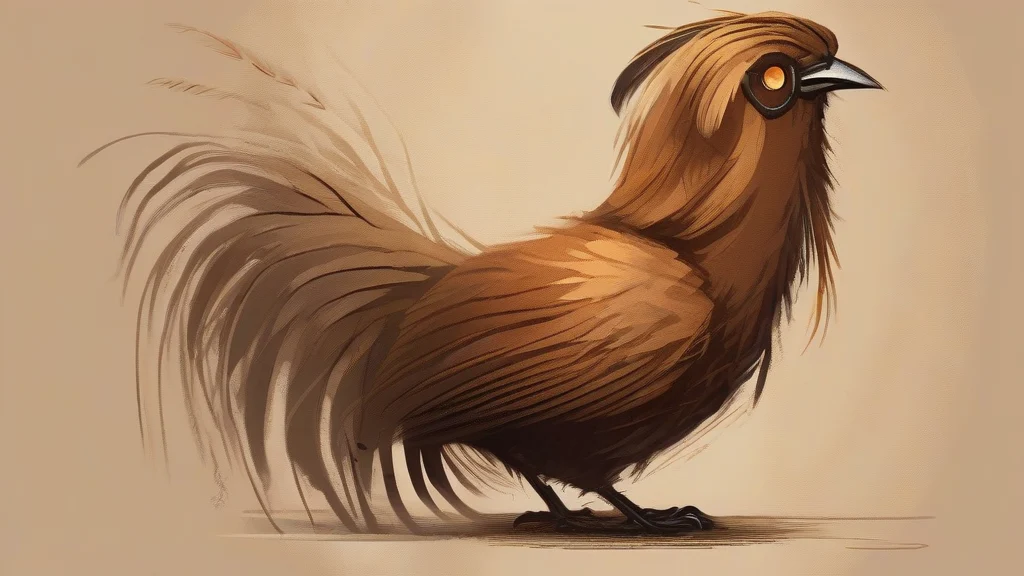
What does hackle mean?
Hackle most often refers to the long, stiff feathers around the neck of a cock or another male game bird. These feathers are valued by fly tiers, who use them to form the soft, mobile sections of artificial fishing flies. The word can also denote a fly made from such feathers. A second group of meanings concerns coarse hair along the back of a person's or animal's neck. When a dog's hackles rise, the animal is frightened, alert, or angry, and people figuratively say that something raises their hackles when it provokes fear or indignation. As a verb, hackle can refer to combing flax with a toothed implement, a textile process also associated with the related form heckle, and historically to cutting away a cock's comb and wattles. Although many of hackle's uses belong to specialist or older vocabulary, its principal associations are feathers, flies, and the raised hair of an alarmed animal.
A long, stiff feather on the neck of a male gallinaceous bird, especially a domestic cock; an artificial fly made with such feathers; or coarse hair on the back of the neck.
"The maker wound soft hackle around the hook to give the artificial fly movement."
The feather and fly senses are common in fly tying, while the neck-hair sense is especially associated with animals standing alert or hostile.
To comb or dress flax with a hackle. Historically, it can also mean to cut the comb and wattles of a cock to prevent it from mating.
"Workers hackled the flax to separate and straighten its fibers."
The plural is standard for the neck feathers or neck hairs, particularly in the expression of raised hackles indicating fear, alertness, or anger.
"The cat's hackles rose when it saw the dog through the window."
A cock's proud neck feathers can become a delicate fishing fly, giving hackle a second life on the water.
Reviewed by Deb Chak, Editor. AI-assisted content curated by RJS Tech Solutions LLP.
Where does hackle come from?
Hackle comes through Middle English from Old English hacel, a term associated with a hood or cloak and with feathers around a bird's neck. Related forms, including heckle and hatchel, also developed in the context of combing flax. The modern meanings preserve both the bird-feather sense and the older association of a covering around the neck, while the verb acquired separate agricultural and textile uses.
Related word forms
How hackle is actually used
The word is mainly specialized in poultry keeping, fly tying, and textile work. The sense meaning to cut a cock's comb and wattles is now chiefly historical or specialist, while expressions involving raised hackles are common in figurative English.
Easily confused with hackle
Hackle is the usual modern spelling, while heckle is a variant associated especially with combing flax and figurative criticism or questioning.