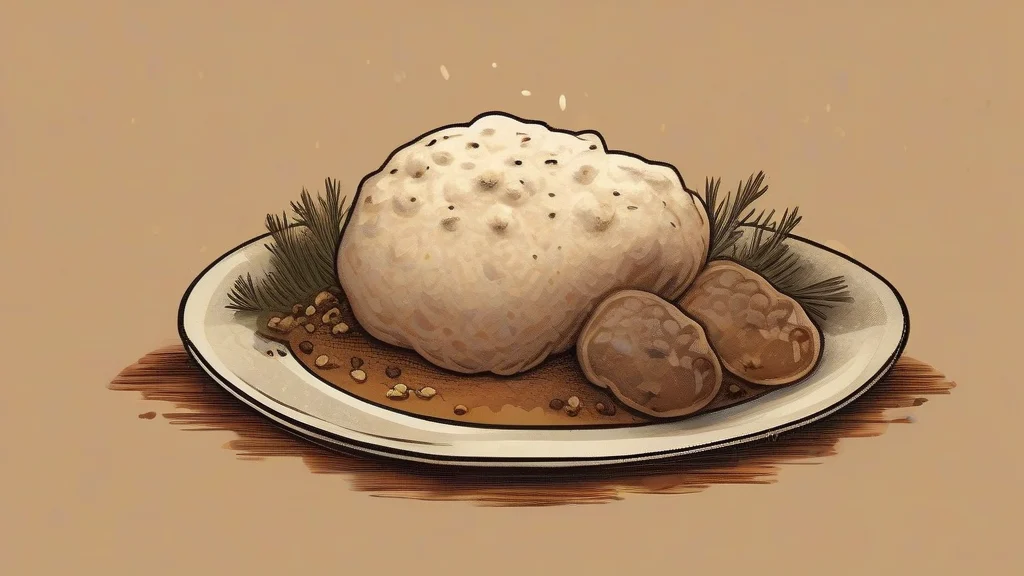
What does haggis mean?
Haggis is a traditional Scottish dish made from sheep's heart, liver, and lungs, mixed with various ingredients and cooked in the animal's stomach. It is often served on Burns Night, a celebration of the life and works of Scotland's national poet, Robert Burns. The dish has a rich history and cultural significance in Scotland, and its unique flavor and texture have made it a popular delicacy around the world. Haggis is often served with mashed potatoes and turnips, known as 'neeps and tatties'. The dish is a staple of Scottish cuisine and is often enjoyed during special occasions and celebrations.
nounA traditional Scottish dish made from sheep's heart, liver, and lungs, minced with onion, oatmeal, suet, spices, and salt, traditionally encased in the animal's stomach and simmered for several hours.
- A traditional Scottish dish.
- A food item often served on Burns Night.
"The Scottish chef carefully prepared the haggis for the traditional Burns Night supper."
"The Scottish chef carefully prepared the haggis for the traditional Burns Night supper."
"Haggis is often served with mashed potatoes and turnips, known as 'neeps and tatties'."
Both 'haggises' and 'haggis' can be used as the plural form, although 'haggis' is more commonly used.
"The restaurant served several haggis dishes throughout the evening."
Reviewed by Deb Chak, Editor. AI-assisted content curated by RJS Tech Solutions LLP.
Etymology of haggis
The word 'haggis' is believed to have originated in the 15th century, possibly from the Old French word 'hagis', which referred to a type of sausage. The dish itself has its roots in medieval Scotland, where it was made with sheep's pluck (heart, liver, and lungs) and cooked in a variety of ways. Over time, the recipe for haggis evolved and became standardized, with the addition of ingredients such as oatmeal, suet, and spices.
How haggis is actually used
Haggis is often associated with Scottish culture and is traditionally served on Burns Night (January 25th).