
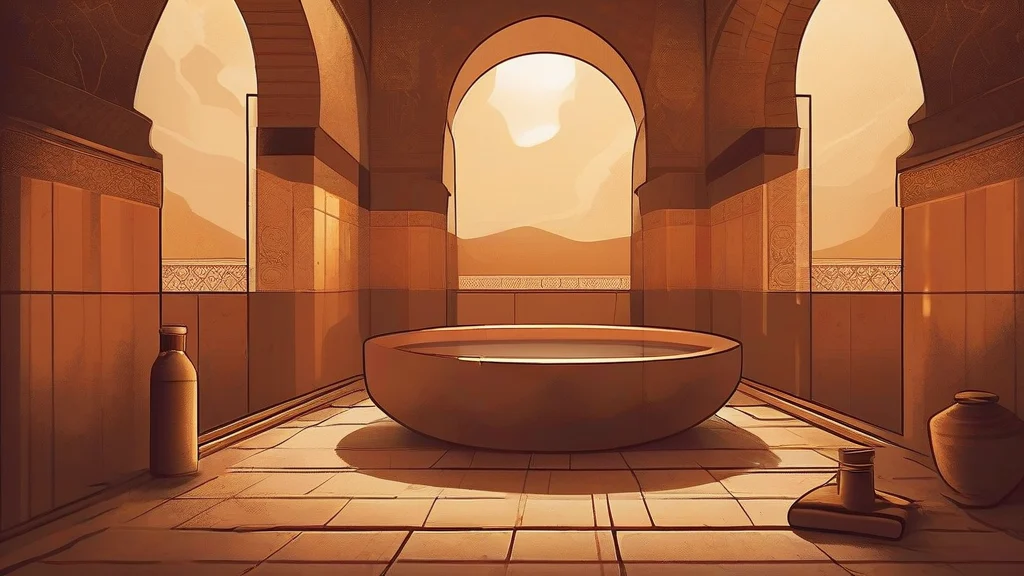
What does hammam mean?
A hammam is a traditional bathhouse or bathing treatment associated especially with Turkey, the Middle East, and North Africa. The word can denote the place itself, often a complex of hot, warm, cool, and massage rooms, as well as a bath in which heat, steam, water, exfoliation, and massage are combined. Historically, hammams were not merely places for personal cleanliness; they served important social, recreational, and therapeutic roles. The term is now used in English for both traditional bathhouses and spa-style treatments inspired by them. Its associations with Turkish and Middle Eastern culture make it more distinctive and culturally specific than the general word "bath," while contemporary usage sometimes gives it a luxurious or wellness-oriented connotation. Visiting a hammam or receiving a hammam treatment remains a recognizable part of the culture of many cities across the region.
nounA hammam is a traditional bathhouse, especially one associated with the Middle East, North Africa, and Turkey. It may refer to the bathhouse itself or to a Turkish-style bathing treatment involving heat, steam, water, and massage.
- A traditional public bathhouse, especially in the Middle East and North Africa.
- A Turkish bath or Turkish-style bathing treatment.
"They visited the old hammam in the medina, where the warm stone rooms and marble floors had served bathers for generations."
"The hammam is an important part of the neighborhood's social life."
"They booked a hammam treatment, including a scrub, steam bath, and massage."
The standard plural of the noun is "hammams," used for multiple bathhouses or treatments.
"The city is known for its hammams, many of which date from the Ottoman period."
The hammam is more than a bath: it is a social institution, a wellness ritual, and a living piece of architectural history.
Reviewed by Deb Chak, Editor. AI-assisted content curated by RJS Tech Solutions LLP.
Where does hammam come from?
The English word comes through Turkish "hamam," which in turn derives from Arabic ḥammām, meaning a bath or heated bathhouse. The Arabic term is associated with the root ḥ-m-m, relating to heat or warmth, reflecting the central role of heat and steam in the bath. The forms "hamam" and "ḥammām" represent closely related Turkish and Arabic forms, while "hamām" is a corresponding Persian form. The spelling "hammam" became established in English for referring to the bathhouse and the bath tradition more broadly.
Related word forms
How hammam is actually used
The word is usually associated with Middle Eastern, North African, and Turkish bathing traditions. In English, it can refer either to the bathhouse as a place or to the bathing procedure itself, and it is generally more specific than the ordinary word "bath".
Easily confused with hammam
Hamam is the Turkish spelling of the word, while hammam is the spelling commonly used in English for the traditional bathhouse or Turkish-bath tradition.