
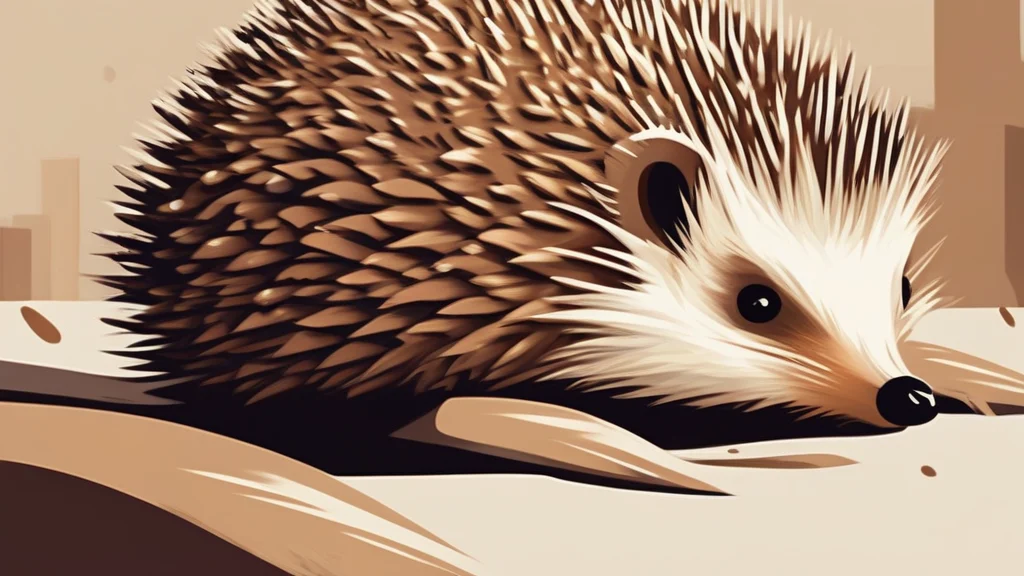
What does hedgehog mean?
A hedgehog is a small mammal, native mainly to Europe, Asia, and parts of Africa, whose back and sides are covered with sharp spines. When threatened, many hedgehogs curl into a ball so that their spines face outward and provide protection. The word is also used figuratively for someone who is unusually cautious, guarded, or reluctant to commit to an opinion or course of action, comparing that person’s prickly defensiveness to the animal. In ordinary use, “hedgehog” can refer to the animal itself, while “hedgehogs” is the standard plural. The word is useful both as a precise name for a distinctive mammal and as a vivid metaphor for a person who keeps others at a distance.
nounA small, typically nocturnal mammal with a coat of sharp spines, found in Europe, Asia, and parts of Africa. Figuratively, the word can refer to a cautious or guarded person who avoids commitment or keeps others at a distance.
- A small, spiny, usually nocturnal mammal of the family Erinaceidae.
- A figurative term for a person who is guarded, cautious, or unwilling to commit to a position.
"The hedgehog curled into a tight ball, presenting its spines to the approaching fox."
"A hedgehog crossed the garden path while the dog watched from a safe distance."
"He remained as guarded as a hedgehog, offering no support for either side in the dispute."
The standard plural adds “-s.”
"Several hedgehogs forage in the garden after dark."
A hedgehog can turn its spines outward and roll into a tight ball, turning its own body into a surprisingly effective shield.
Reviewed by Deb Chak, Editor. AI-assisted content curated by RJS Tech Solutions LLP.
Where does hedgehog come from?
“Hedgehog” is an English compound formed from “hedge” and “hog,” with both elements having Old English roots. The compound developed in Middle English and combines an animal that shelters among hedges with an older word associated with a pig or hog-like animal. Its modern form preserves this long-established composition, with “hedge” also appearing in related words such as “hedgerow” and “hedger.”
How hedgehog is actually used
As an animal name, the word is standard and informal-neutral. The figurative use is generally informal and may suggest excessive caution, defensiveness, or unwillingness to take a clear position.
Easily confused with hedgehog
Hedgehogs are small mammals with short, flexible spines, whereas porcupines are generally larger animals with long, stiff quills and belong to a different group.