
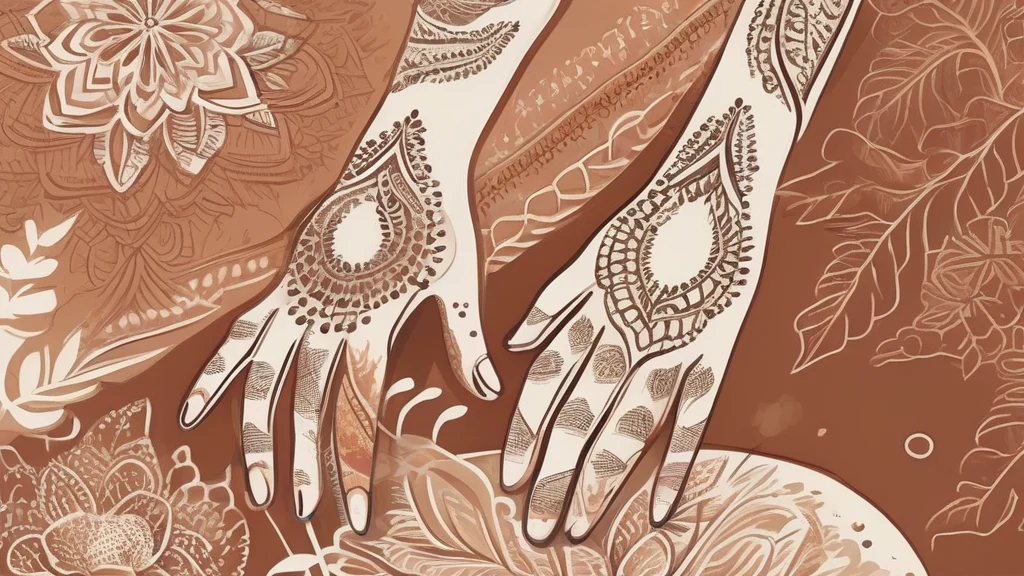
What does henna mean?
Henna most often refers to a powdered or paste dye derived from the leaves of Lawsonia inermis, a shrub or small tree. Applied to skin, hair, fabric, or leather, it produces earthy yellow-brown to reddish-brown tones. The word can also mean the plant itself, the coloring material, or a particular reddish-brown color. In beauty and body-art traditions, henna is especially associated with South Asian, Middle Eastern, and North African customs, though its use is not limited to any one region. Contemporary henna artists combine the traditional dye with individual designs, making it both a practical coloring substance and a form of decorative expression. Because the dye changes as it oxidizes, the result may look warmer or deeper than the original paste, and the word remains useful for discussing both the plant and the many cultural practices associated with its use.
A reddish-brown dye or paste made from the leaves of Lawsonia inermis and used to color skin, hair, fabric, or leather; also the shrub itself or the color it produces.
"The henna has dried to a deep reddish-brown."
To color or decorate something with henna.
"The stylist hennaed the bride's hands with a floral pattern."
This verb form is much less common than the noun.
The plural is limited and usually denotes individual henna designs or applications; the substance itself is normally uncountable.
"The artist showcased several intricate hennas at the festival."
Henna can begin orange-brown and deepen as it oxidizes, so its final color is partly written by chemistry.
Reviewed by Deb Chak, Editor. AI-assisted content curated by RJS Tech Solutions LLP.
Where does henna come from?
The English word dates from the 16th century and comes from the Arabic ḥinnāʾ, the name of the plant and its coloring substance. The related South Asian term mehndi and the French form henné were likewise borrowed into their languages from the same Arabic source. Henna has long been used not only as a commercial dye but also in ceremonial and cosmetic body decoration across South Asia, the Middle East, and North Africa.
Related word forms
How henna is actually used
Henna is normally uncountable when referring to the substance, as in "henna paste" or "henna dye." The countable form is occasionally used for an individual design or application, especially in beauty and body-art contexts. Its use in South Asian, Middle Eastern, and North African traditions carries cultural significance that should not be reduced to a generic tattooing practice.
Easily confused with henna
Henna is a shrub and source of reddish-brown dye, whereas senna is a plant whose dried leaves or pods are used as a laxative.