
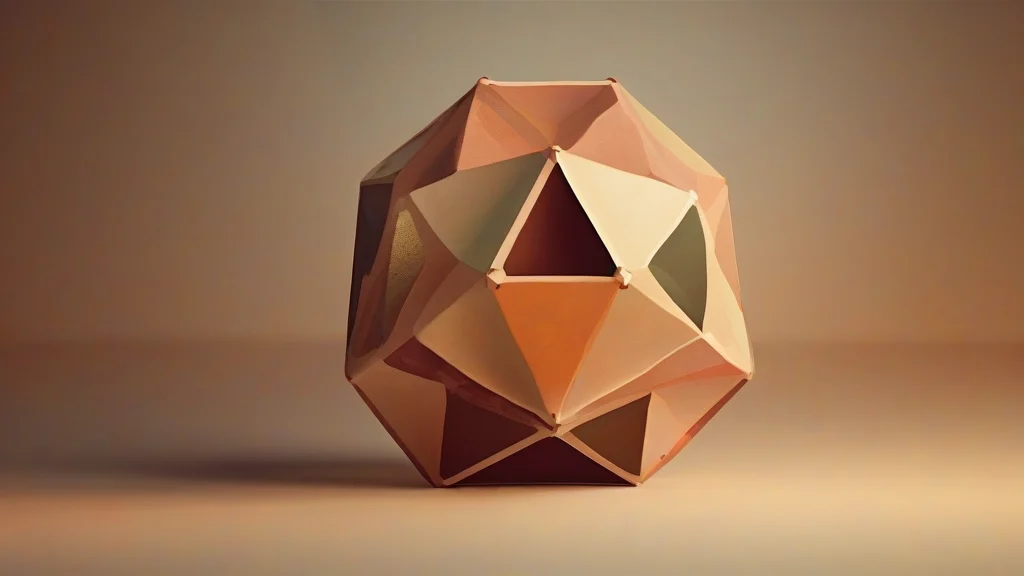
What does heptahedron mean?
A heptahedron is a three-dimensional polyhedron with seven faces, each face typically being a polygon. The word belongs primarily to geometry, where it can refer to regular, irregular, convex, or non-convex forms; it is not limited to a single familiar shape. A regular heptahedron has faces of congruent regular polygons arranged symmetrically, while an irregular heptahedron may have faces of different shapes and sizes. The term is also useful in art, architecture, crystallography, and technical description when a form needs to be identified by its number of surfaces. In general writing, “seven-faced solid” or “seven-sided solid” may be clearer for readers unfamiliar with the formal term. The standard plural is “heptahedra,” while the related adjective “heptahedral” describes something having the form or properties of a heptahedron.
nounA heptahedron is a three-dimensional polyhedron with seven faces. In geometry, the term is used for any solid bounded by seven polygonal faces, whether convex or non-convex.
- A polyhedron having seven faces.
"The sculpture resembles an irregular heptahedron, with seven angular surfaces catching the light."
"The model was a regular heptahedron assembled from triangular panels."
"In the study of convex solids, the heptahedron illustrates how different arrangements of faces can produce distinct geometric forms."
“Heptahedra” is the standard plural; “heptahedrons” is occasionally encountered but is less conventional.
"Several distinct heptahedra are illustrated in the geometry textbook."
Seven faces, one highly specialized name: a heptahedron is the three-dimensional counterpart of a heptagon.
Reviewed by Deb Chak, Editor. AI-assisted content curated by RJS Tech Solutions LLP.
Where does heptahedron come from?
The word was formed through the mathematical combining form hepta-, from Greek heptá, meaning “seven,” together with -hedron, from Greek hédra, meaning “seat,” “base,” or “face.” This follows the established pattern of English geometric terms such as tetrahedron and hexahedron, which likewise use Greek-derived combining forms to specify the number of faces. Heptahedron therefore literally means “a seven-faced solid.” Its related forms include the adjective heptahedral and the standard plural heptahedra.
Related word forms
How heptahedron is actually used
This is a specialized geometric term, used chiefly in mathematics, architecture, and technical descriptions of three-dimensional forms. It is uncommon in everyday speech, and “seven-sided solid” may be used for general audiences.
Easily confused with heptahedron
A heptahedron is a three-dimensional solid with seven faces, whereas a heptagon is a two-dimensional polygon with seven sides.