
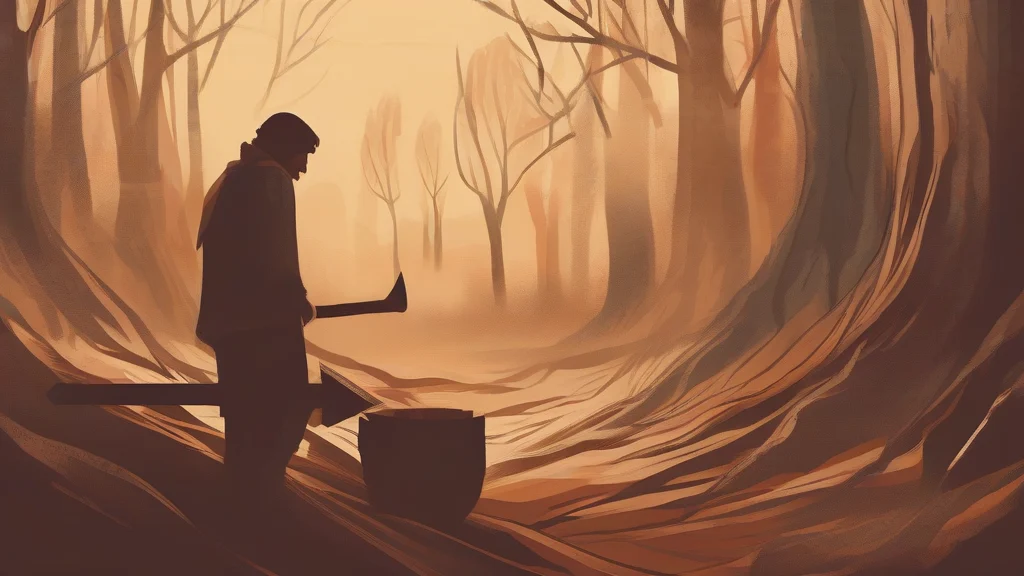
What does hewer mean?
Hewer is a now chiefly literary or historical noun for a person who cuts, splits, or shapes wood or stone with an axe or similar hand tool. The best-known traditional example is a "wood-hewer," while "stone-hewer" refers to a worker who dressed building stone. The word is closely tied to the verb "hew," whose older sense was to cut down or chop and whose ordinary modern sense is to cut or shape material. Although a hewer can be compared with a woodcutter or lumberjack, "hewer" often suggests an occupational name from an earlier, craft-based society rather than a casual modern synonym. It survives especially in historical writing, descriptions of labor, and phrases such as "hewer of wood." The word is useful because it names not merely the action of cutting but the person who performs it, while also preserving a distinctly occupational register.
nounA person who hews, especially one who cuts wood or dresses stone by hand.
- A person who hews material, especially a woodcutter or a worker who cuts and shapes stone.
"The old hewer raised his axe and continued cutting the seasoned oak."
"The timber hewer worked from dawn until the light failed."
"Every stone-hewer left the marks of his tools across the unfinished wall."
The regular plural is used when referring to multiple workers, usually in historical or literary contexts.
"The hewers divided the timber into sections fit for the builders."
From chopping timber to carving cathedral stone, the hewer was the worker behind the axe.
Reviewed by Deb Chak, Editor. AI-assisted content curated by RJS Tech Solutions LLP.
Where does hewer come from?
Hewer is an agent noun formed from "hew" with the occupational suffix "-er." The verb comes from Old English hewan, meaning "to cut down" or "to chop," and ultimately from a Germanic root shared with forms such as German hauen and Dutch houwen. The related word "hoe" also comes from the same Germanic root.
Related word forms
How hewer is actually used
Chiefly literary, historical, or occupational. It is uncommon in ordinary modern speech but remains familiar through expressions such as "wood-hewer" and "stone-hewer."